Solution brief Devices as Instructional Infrastructure

By Insight Editor / 19 May 2026 / Topics: IT optimization , Devices , Device lifecycle
Key takeaways
- Devices are mission‑critical for K–12 instruction. Reliable access enables daily teaching, testing, communication, and student services.
- Reactive device management drives cost, risk, and disruption. It causes lost class time, inequity, and unpredictable budgeting.
- Lifecycle management improves stability and outcomes. Proactive planning aligns devices with budgets, security, and learning goals.
How educators can rethink device management before the next disruption.
Device reliability has become a leadership imperative
Digital devices are now as essential to K–12 instruction as staffing, transportation, or facilities. Daily teaching, assessments, accessibility services, and family communication all depend on devices working reliably in every classroom, every period. Yet in many districts, device management remains fragmented across IT, procurement, and schools, with limited visibility for administrators.
This gap is becoming harder to ignore. Superintendents, CIOs, and curriculum leaders face pressure to accelerate learning recovery, advance equity, protect student data, and budget responsibility — while federal relief funding sunsets and large device fleets approach end of life. At the same time, cybersecurity incidents targeting schools continue to rise, and critical testing windows leave little tolerance for failure.
The resulting question is: When instruction increasingly depends on technology, can districts afford to manage devices reactively rather than as mission-critical infrastructure?
The hidden cost of reactive device management
When device environments are managed reactively, the impact extends far beyond IT. Instructional time is lost as teachers troubleshoot issues or wait for replacements. Equity goals suffer when access to functioning devices varies by campus. Budget planning becomes unstable as large replacement needs emerge unexpectedly, often outside normal funding cycles.
Operational strain follows. IT teams spend disproportionate time on ticket resolution, inventory tracking, and emergency deployments, limiting their ability to support curriculum enrichment or security improvements. Financially, districts absorb higher total costs through last-minute purchases, shortened device lifespans, and inefficient refresh cycles.
At the district level, these challenges complicate leadership’s ability to deliver on what students, parents, and educators expect. Superintendents and district leaders are increasingly accountable for student data protection, regulatory compliance, and responsible use of limited funds. Without a clear view of device condition, security posture, and lifecycle costs, leaders end up reacting to issues instead of setting a long-term direction. Device management is no longer a back-office task — it directly shapes the learning experience and the district’s ability to deliver on its commitments to students and the community.
How future-ready districts are managing devices at scale
Forward-looking districts are shifting from ad hoc device support to lifecycle-based management. Rather than focusing solely on procurement, they plan for deployment, support, refresh, and secure disposition as a single, integrated system aligned to instructional priorities.
Common practices among these districts include:
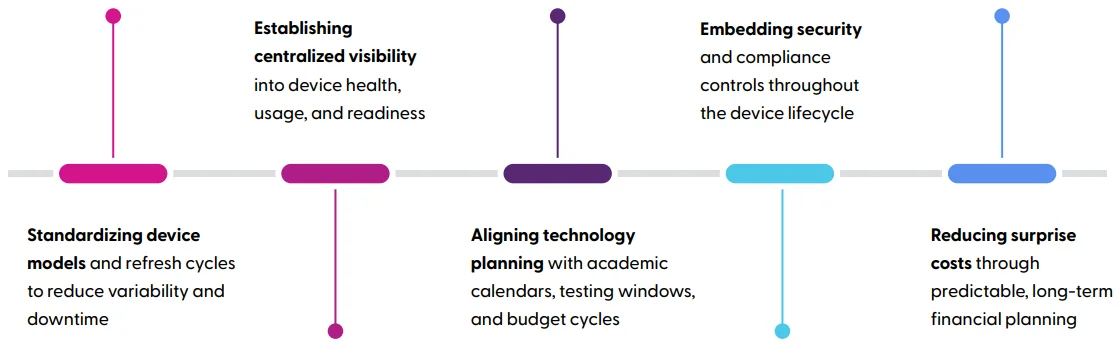
Higher education institutions underwent a similar transition as digital learning scaled across campuses. Those that acted early reduced disruption during critical academic periods and improved overall student engagement. K–12 districts now operate at comparable scale and complexity. Leaders who treat devices as strategic infrastructure — rather than distributed assets — are better positioned to deliver consistent instruction and manage risk as digital dependence continues to grow.
What district leaders should be evaluating now
As device dependence increases, district leadership teams should frame the discussion around strategy rather than operations. Key considerations include:
Timing:
Upcoming refresh cycles, expiring warranties, testing seasons, and curriculum rollouts create natural decision points.
Visibility:
District IT professionals should be able to confidently answer how many devices exist, where they are, and their current condition.
Risk posture:
Device security, data protection, and end-of-life handling are governance responsibilities, not technical afterthoughts.
Financial sustainability:
Long-term models must balance instructional needs with predictable budgeting and responsible asset reuse.
Organizational capacity:
Time spent managing devices is time not spent supporting educators, students, and strategic initiatives.
These considerations equip leaders to engage productively with boards, finance teams, and instructional leadership around technology decisions that directly affect learning outcomes.
A pragmatic path to stability and predictability
High-performing districts typically approach modernization in deliberate stages rather than reacting to crises. Many begin with a focused assessment of their current device environment, examining fleet health, instructional impact, security exposure, and long-term cost trends.
From there, district leadership bring together academics, IT, finance, and operations to establish shared priorities and constraints. Planning then connects device lifecycle decisions to budget cycles, refresh schedules, and major digital initiatives, ensuring changes support — not disrupt — teaching and learning.
The objective is not rapid transformation, but stability and predictability. By operationalizing a proactive lifecycle model before the next testing window, refresh cycle, or security incident, districts reduce risk and gain control over an infrastructure that underpins every classroom.
Connect device strategy to learning outcomes
To move forward, district leaders should elevate device lifecycle management into the same conversation as curriculum, staffing, and funding — recognizing it as core to how learning happens every day. This may include commissioning a rapid assessment, quantifying instructional time lost to device issues, or modeling future cost and risk exposure under the current approach.
Taking these steps ahead of the next testing window, refresh cycle, or major digital initiative gives districts room to act deliberately. Device decisions can then be aligned with instructional goals and classroom needs, while supporting responsible budgeting, instead of scrambling during a crisis.
Why Insight Public Sector?
Insight Public Sector, a division of Insight Enterprises, a Fortune 500 Solutions Integrator, helps federal, state, and local government agencies and educational institutions solve complex technology challenges. With 35+ years of deep technical expertise and robust industry partnerships, we combine the right hardware, software, and services to drive real transformation.
Let’s do big things together.
Innovating is the only way to stay relevant in today’s uber-competitive market. Our unique approach and deep knowledge put you on the path to true innovation.