Subscribe Stay Updated with Insight On
Subscribe to our podcast today to get automatic notifications for new episodes. You can find Insight On on Amazon Music, Apple Podcasts, Spotify and YouTube.
By Insight Editor / 28 Jan 2026
If you’re responsible for people, budgets, and outcomes in K–12 or higher ed, you’ve probably heard the pitch: “We just need one more program.” In this episode of Insight On, you’ll hear about the rare case where that’s actually true.
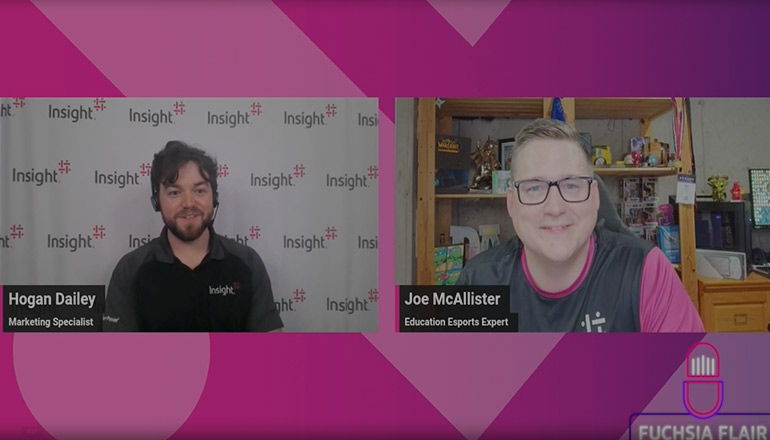
Host Jillian Viner talks with Joe McAllister, senior business development manager at Insight and former high school math teacher, about how esports in schools are improving enrollment, attendance, and GPAs — especially for students who aren’t reached by traditional activities.
Joe breaks down how structured esports programs deliver social-emotional learning, communication, and teamwork by bringing gamers out of bedrooms and into supervised, face-to-face environments. He shares research-backed insights on sleep, nutrition, and fitness — including why “every minute you play after midnight makes you a worse player.”
You’ll also hear a few counterintuitive truths, including how some research shows no correlation between violent games and violent behavior, though many school programs still focus on nonviolent, team-based games. Esports also drive equity in a way few programs can, giving students across ages, genders, and abilities — including wheelchair users and autistic students — the chance to compete, lead, and even letter in varsity esports.
Finally, Joe connects esports directly to college and career: millions in annual college esports scholarships; real roles in broadcasting, marketing, IT and management; and a practical roadmap for starting small. Most schools begin with a $5–10K investment and grow into campus-wide impact as labs double for CAD, VR, and digital media.
If you need one program that hits engagement, outcomes, and future-ready skills — this conversation is your next step.
If you liked this episode, share it with a colleague.
Have a topic you’d like us to discuss or question you want answered? Drop us a line at jillian.viner@insight.com
— Joe McAllister, Senior Business Development Manager
Audio transcript:
Joe McAllister:
Surprising to folks who aren't in it. And probably one of my favorite things is the equity of eSports. Doesn't matter if you're male or female. I've seen eighth graders destroy seniors in high school. Right? Uh, I have, um, seen folks who are wheelchair bound, win a state title, win a varsity letter. Um, uh, I worked with a school in New Jersey, so, so that he, this kid could compete. Uh, at the national level,
Jillian Viner:
If you're making technology decisions that impact people, budgets and outcomes, you're in the right place. Welcome to Insight on the podcast for technology leaders who need tech to deliver real results. No fluff, no filler, just the insight you need before your next big decision. Hi, I am your host, Jillian Viner, and today it's Game on with Joe McAllister, senior business Development manager here at Insight Writing our eSports program. And he's got some insights that will help even non-gamers level up. Let's go. I grew up with Mario Brothers and Duck Hunt. Yeah. That was my introduction to video gaming kind of fell out of it for a while. That's fair. I have to say though, the people that I, that I do know who are gamers, yeah. They are very, um, just intellectually sharp, which we'll we'll talk about here. Sure, sure. Um, but I figured we would turn this into a little bit of a video game in the sense that I'm going to be your opponent here. Oh, okay. We're gonna go head to head, because eSports is something that is not necessarily new in the grand scheme of things. Correct. It's definitely come around, but there are still some stigmas, some misconceptions and challenges. And so I want to be your villain in a scenario. Love it. And I'm just gonna throw you everything I got. Okay. And you're gonna fight back.
Joe:
This is my favorite
Jillian:
I'm very, a little bit of Mortal Kombat. Okay. Okay. Okay. Uh, , which, by the way, mortal Kombat, was that ever, was there ever a strategy to that? Or was it really just Oh, no. Yeah,
Joe:
Yeah. Lots of strategy there. Okay. Um, yeah. There's, there's a whole, uh, fighting game community around it
Jillian:
Still to this day. Oh, yeah. Has it evolved?
Joe:
Oh, yeah. Very much so. Um, yeah, because the, the frames in which the things could be rendered mm-hmm . Are so much better. Yeah. That like, it really allows that player to really have that like, input to it, to like, the quicker your reaction time is, the better you're gonna be. Okay.
Jillian:
Well, Joe, you are probably the best person to have an eSports conversation with because you have been ingrained in this probably since you were a child. But what I think is so valuable about what you bring to this conversation is that you, yourself are once a teacher.
Joe:
Yeah, absolutely. Yeah. I taught high school math for six years, um, helped run gaming clubs during that time. Actually, when I was in college, I started our gaming clubs. So, yeah, I, uh, I describe myself as patient zero for a lot of people when it comes to gaming. Uh, but yeah, the education background and seeing kids learn really, you know, helps with this, especially when I understand what folks are going through in their daily lives as they're trying to start up an eSports program.
Jillian:
What made you interested in not only doing gaming, but making it a hobby that you would then, you know, develop clubs in college and, and do that professionally like that? I imagine eSports wasn't necessarily that big when you started doing it when you were a teacher.
Joe:
No, absolutely not. And I mean, it all, it goes back to my childhood, honestly. Like, uh, my mother has been in it my entire life and she's a gamer. So like, I'm a second generation gamer. Uh, one of my favorite things is when I woke up from a nightmare as a small child, my mom's playing Tetris on regular Nintendo. You know, so like, it, it's been just a a through thread in my life for forever. So I've always been gaming. Right. And, uh, another thing about me is I'm not shy about that. So like, I am happy to talk about video games with anybody . And like, as, as you teach, one of the things you learn is getting to know your students and find out what motivates them is a really good way to get them to perform in your class. So, you know, a lot of kids I'd, you know, line up with them on video gaming and that type of thing. So that's what made it easy to be like, oh yeah, you guys wanna do that? Like, let's, let's start building. What
Jillian:
Is eSports?
Joe:
ESports is competitive video gaming. So at its core it's just anytime you compete. Uh, one of my favorite things is, uh, technically back in the seventies and early eighties when arcades were becoming big, that was eSports. We just didn't call it that.
Jillian:
That's interesting that you say that you're not shy. 'cause I'm gonna hit you with one of my, my attack moves right now. Sure. One of the criticisms about eSports and gaming in general is that it is potentially an encouraging meth mechanism for isolation. Absolutely. Is that something that you see?
Joe:
Yeah. Well, um, actually, so one of the reasons that we have it in education is to combat that, right? So there's like this, this idea, the stereotype that gamers want to be alone. They like to be in their parents' basement, drinking Mountain Dew eating, Cheeto, like that whole stereotype, right? Mm-hmm . But that's not the truth. Um, in fact, the gaming industry has made that kind of the norm because that's how they make the most money, right? We used to play co-op, like our friends would come over, we'd play four people on a screen, and now you really can't do that. You have to be online and everybody has to have their own unit, right? Whatever we're playing PC console, whatever it is. So it's kind of driven us to do that as a, as a gaming community. Whereas when we have it in the school, it becomes a social setting. Right? And, and a safe space too. Uh, because now we we're taking people outta the basement, we're taking them out of the bedroom, and we're making them interact with people face to face. 'cause there's a big difference in the interaction behind a keyboard versus that face to face. So we're actually improving students' ability, and in education we call it social emotional learning. So we're actually helping them understand how to interact, how to, you know, do those things. Especially if they have had an isolated lifestyle up until that point.
Jillian:
So when they come into a room that's designed for an eSports program, they're not just walking into a room, going to a computer, putting on, I would say a headset mm-hmm . And not talking to anybody. No, there is engagement there. And even in the game, there's engagement. Well,
Joe:
And that's why in education, both higher ed and K 12, most of the popular games are team-based games. You have to com you have to communicate, you have to be a good teammate, you have to, like, all those soft skills that we love from traditional sport, we're bringing into this in a very real manner. Right. And, you know, I like to call it the solo cue mentality, where kids are used to just jumping into a game recreationally and then never seeing those players again. But when we play at school, it's Susie from my fifth period mm-hmm . Is my teammate, or Jim, who's my friend from football, is my teammate. Right. These are not strangers. These are not people you're never gonna see again. So you conduct yourself in a completely different manner and understand how to work together as a team and how to get the best outta your team and some of the behavior from that, you know, isolated mentality. Uh, we can work through and we can actually get them to be better communicators, which, you know, when we look at job skills, that's what we're looking for in, in folks. So,
Jillian:
Okay. So communication is there, but you've given me another piece of ammo. Please. You talked about, this is my teammate, maybe from my football team, maybe from my other class. Yeah. But eSports, you're sitting in a chair, you're looking at a screen. Mm-hmm . eSports very easily can encourage unhealthy habits. You're, you're sedentary. Mm-hmm
Joe:
Yeah. If left to their own devices. Sure. But that's one of the reasons that we have it in a school, right. Is because there is a, a, an adult there to talk about those things. Um, if you look at most professional organizations right now, you won't see that many overweight players anymore. They have found out through scholarly research that your synapsis fire better when you're in shape. Right. So if you are eating right, you're sleeping right. You're working out, you're actually a better video game player. And when, like, when I talk to schools and kids are like, how do I get better? Blah, blah, blah, blah, blah. I'm like, number one, it every minute you play after midnight makes you a worse player. Uh, if you're not sleeping right, you won't play right. You need to eat right so that you can feed the machine.
Joe:
The machine is, your brain thinking actually brings calories. So you need to fuel the machine correctly. And then you also need to work that machine out. Right? It's not like traditional sport where we're like, oh, we need to get faster. We need it stronger. You know, I was a collegiate wrestler once upon a time. There were things I trained for, right. Snapping people down, that kind of stuff. We don't do that in eSports, which I actually love because it teaches kids how to work out for fitness, not for training, which is a very big delineation. Um, and so we're able to get students exposed to that kind of thing where, yeah, we'll go to the gym once or twice a week, you know, and folks who had no interest in that whatsoever. Now understand that there is validity to doing that, and you can become, you can make a bigger gain in your gameplay by doing those things for your body than playing an extra 10 hours a day.
Jillian:
Interesting. So you're combating the lack of sleep. Mm-hmm . Uh, and, and this, the, the sedentary by saying that these are all components to make you think better, sharper, which I think about that in the business world as well. Like knowledge workers, quote unquote, we're sedentary at a desk all day long. So those reminders of like, look away from the screen and you know, when you're not working, go, go do workouts, go lift weights, go do some squats. 'cause you're sitting in a chair all day long. All of that is very
Joe:
Similar. You should put time on your calendar to get up and move. Mm-hmm . You know, like, just get up and move. Even if it's upstairs, whatever it is. Uh, get up and move. 'cause it, you need to, you're, you're not at your pink for thinking by, by putting, sitting in the chair all day, you know, blood pools in your legs. Like you gotta get things moving mm-hmm . In order to be the best at your job. And that translates directly to eSports.
Jillian:
Okay. I'm gonna throw one more pretty common criticism at you, which, when you think about video games, a lot of them are fighting war simulators. Sure. These are games that potentially encourage violence or even apathy, right? Sure. We become kind of immune to these scenes. So how do you combat that?
Joe:
It's interesting. There's, so there's a number of different things. Uh, number one, a lot of people's misconceptions is that eSports is either Call of Duty or Madden. And there's just so many more games than that. Uh, in fact, in education, one of the more popular games is Rocket League. Rocket League is soccer with Go-Karts.
Jillian:
I've actually played it. It's really hard. Yes,
Joe:
It is. It, the learning curve on that game is incredible. So, you know, props to our Rocket League players out there, but, uh, yeah, it's so we're not always playing violent video games. Um, and there's a lot of folks not, and there's some schools that, especially like elementary or middle school, they're just, yeah, we're not gonna play those games. And that's okay. That's absolutely okay if that doesn't align with your values. Also, there's been a lot of scholarly research, notably by Oxford, that shows that there's no correlation between a violent video game and a violent human. Uh, so it's actually more of a cultural misunderstanding and a misconception that we have to handle community by community that we have actually proven beyond a doubt that that actually there is actually no correlation there. Right. It's just how we feel about it, which is valid. And I don't want to, you know, invalidate anyone's feelings, but we should have a conversation about how much benefit this has for the students versus our cultural, um, baggage that we're bringing to the table here.
Jillian:
Okay. If we were in fact playing Mortal Kombat, I think this is the point where my character would be like, , you know, sweating and swaying about to go down. You just gotta throw me one more punch. . Um, I'm not gonna throw another punch at you, but based on what you've told me so far, you know, the programs do teach collaboration, communication, it does encourage healthy habits. Mm-hmm . Such as moving around physical fitness, eating right, uh, getting well, good sleep. There are games that are not necessarily violent games that are, you can play. What do you think is the most surprising benefit of eSports?
Joe:
Uh, surprising to folks who are in it, and probably one of my favorite things is the equity of eSports. What do you mean? So doesn't matter if you're male or female, doesn't matter if we, I've seen eighth graders destroy seniors in high school. , right? Uh, I have, um, seen folks who are wheelchair bound, win a state title, win a varsity letter, um, uh, worked with a school in New Jersey, so, so that he, this kid could compete, uh, at the national level. Um, he's a quadriplegic and he uses a controller that works in his mouth, suck, blow, move around with his tongue, uh, it's called a quad stick. Uh, incredible that he's able to compete at a very high level, just like all of his teammates, right. Um, students with, uh, with autism students with other learning dis disabilities, they can compete at the same, if not higher levels than their peers in the school. So they are able to, you know, they aren't just the manager of the basketball team or things like that. They can be the captain of the eSports team, right. The Overwatch team, the, the, uh, rocket League team, whatever it is, and really, you know, have a meaningful experience there and be able to compete in a way that they can't do really anywhere else in the school. So that's the one that, you know, it, I mean, God
Jillian:
That's beautiful right now,
Joe:
You know, it's one of the things that I'm super passionate about, and the Special Olympics has been doing eSports for years. Like, there's a ton of different nonprofit groups that help making able gamers and, and things like that. Microsoft did this awesome thing where they've got this, um, universal controller that you can plug whatever things you need into it for you specifically, and they made it universal. It works with a PlayStation, it works with a computer, it works with whatever, which is just beautiful. Um, and so there's just a lot of really cool support of that community in this space. And that's the, I mean, that's the kind of stuff where I, I'm willing to bend over backwards to make sure those things happen.
Jillian:
That's amazing. That's a really beautiful story. Yeah. Do you also see it sort of crossover between groups at schools? We know bullying is an ongoing issue mm-hmm . Particularly with online platforms. Yeah. Do you have, you know, the prom queens doing this amidst, you know, the art students? Like it's a total blend.
Joe:
Yeah. I, I mean, we want it to be more so, right. It is male dominant right now. Um, and I think as we establish programs and we establish them as safe spaces, because one of my opinions is that, uh, females are just smarter than males. , uh, I'm sure you won't mind that too, too much.
Jillian:
I'm not gonna disagree
Joe:
On that. Uh, but essentially if you just play recreationally online, there's, it can be a very toxic experience. Hmm. Right? So a lot of females go, I don't have to deal with this. There's other things in life than this. Right. And males go, no, I can do it. You know, and they listen to this garbage all the time. Um, and so in a school, that stuff doesn't fly. Right? Like, you can't say those things. Mm-hmm . That's not okay. And honestly, like a lot of few people do it because they don't know the person on the other side of the screen. Right. They feel anonymous and they feel like they can say whatever. Um, so in a school, you're face to face. There's an adult in the room, we're learning how to work together. Right. And so programs that really foster that culture mm-hmm . Allow for more female students to feel comfortable, more different students to be involved in the program. Um, so we are seeing the captain of the football team with the kid who never talks in class, and the kid who never talks in class is teaching that kid how to be better. Um, I'd love to see us more get into, uh, getting more females involved. They are playing. They absolutely are. And we know from data, uh, that females play video games. It's just, we need to make sure that you know, everything and not just for females, for everybody, but is a welcoming environment. Mm-hmm .
Jillian:
You talked a lot about eSports in a school environment mm-hmm . Which is great. Mm-hmm . All said and done. But why spend the time, the energy, the educational funds on something that is going to ultimately end after high school? Or does it end after high school?
Joe:
Right. So there's actually, uh, according to nace, there's a around $25 million scholarship annually to go play collegially. Uh, so there's a number of colleges that have eSports programs, so you can go play on the next level. Um, and the career pathways that you can get into with this, uh, are plentiful. So you can have students explore career pathways while they're doing eSports, which is really fun. Um, it's interesting. I've helped schools with setups like we're talking in today, not to this level. Uh, I have at college campuses for broadcast programs mm-hmm . But like just a school wanting to get started with a, with a stream and, and getting students to understand, to run a show and understand how to put graphics together and getting their art teacher involved in that. And like building all this synergy across the school is really cool. And we're able to do that with eSports. So it isn't just the competition, which we do get soft skill development out of which is worth it. Right. 'cause if you look at other, um, sports in the school mm-hmm . Similar trajectory, right? Like I was a wrestler, you wrestle in college and then what, like 10 people get to be part of the Olympic team and that's it. Right. . And that was never, but it was still very, uh, beneficial to me in my life mm-hmm . To participate in that and to, to have those experiences. So it follows that same trajectory.
Jillian:
Talk to me a little bit more about the career pathing, though. I think the most obvious example that maybe comes to mind is air traffic control. That seems like a very easy connection between interesting gaming and air traffic control. Maybe I'm the one who thinks that what other, I
Joe:
Love that. That's not the normal one that
Jillian:
I get. It's not what's, what's the most common one? Well,
Joe:
Computer science is always
Jillian:
Number one, but if you think about the, the skills that you develop, understanding games, the, and you've mentioned like communication, certainly I don't, what are some other cognitive skills that you would then see as very easy path to a career?
Joe:
Right. Well, and we can look at this through two lenses, right? So soft skills and hard skills, right? So in the soft skills space, we talk about the five Cs, which are the, uh, Google did this whole, um, survey of top CEOs and what they look for employees. And they came up with collaboration, creativity, critical thinking, you know, all these different aspects. We do all of those in eSports, right? So when we are, before we play a game, we're critically thinking about the strategy of how we're going to play that game. Right? There are plays, there are different, uh, things that we do as counters to what the other team is doing, right? And we have to discuss that beforehand. So there's tons of strategy that goes into it. And I mean, you alluded to it earlier where you're talking about, you know, folks who play a lot of video games, especially highly strategic video games.
Joe:
Mm-hmm . They can think through other things extremely well too. Right? And the thing I love about eSports is we're doing that, but we're doing it with a team and we have to take everybody's feedback. And lemme tell you, you use that a ton in the working world, , right? Like you have to work Sure. Work with a bunch of different folks and get their feedback. And you might not necessarily agree, but like everybody else does. So you kind of have to be able to, to work through that with everybody. Mm-hmm . Um, so the soft skill development there of how to work in a team, communication, leadership skills, how to be led, right? Like those two things matter, right? We can't have everybody calling shots. It has to be a hierarchy when we're playing, right? So there's that side of it. And then we can get into like hard skills where we can have kids experience like, oh, you are, you're gonna go put the program together. You have to go around to all the local businesses and pitch them marketing. Right? We're gonna let them be
Jillian:
Part, you're even in the cla you're not even the in the room right now playing the game. Yeah. This is the ancillary,
Joe:
An eSports program is more than just competitive, right? If done what I think is correctly mm-hmm . Um, you are working through the, you know, we need jerseys, we need, uh, we need sponsors for these different, you know, microphones or whatever we need in the space. We're gonna work, go to our local community, we're gonna build a program. We're gonna put 'em on our jersey. We're going to have them be a lower third. Right. And then teaching students about lower thirds and how that all works, right? And then working with our art students, then hey, we need these graphics. We're playing our rivals next week. We need a graphic for before we go live with the broadcast. Right? And then there's the onscreen talent. There's students who actually broadcast the games. They're called shout casters. It's a mix between a hip hop hype man and a color commentary.
Joe:
Okay. Person. They're very excitable. But you have those folks, but then you also have, um, what are called observers who are calling out action. You know, if you've ever watched a football game where you have a box of folks and there's a spotter pointing out who's making the play, how many yards was on that play so that the announcer can say it all very fluidly. We have all of that in eSports, right. So we can, we can create a small little studio essentially for students to get their feet wet in that, if that's somewhere they want to go into. Right. Or they can be a team manager or they can be a strategist for the team.
Jillian:
Wow. There's so much more than I had even thought about. Um, okay. So it sounds like hands down, there's a lot of opportunities and benefits for kids students to get involved. Mm-hmm . Let's talk about what this means for the actual schools and basically the people that have to decide we have X amount of dollars in our budget every year. How do you, do you justify that money for an eSports program is worth it? Particularly in lower income schools where like maybe they don't even have enough budget for the basic equipment they need to run a classroom. Yeah.
Joe:
Yeah. Absolutely. Well, the first message is you can get this started with very little, right? Most programs grow into it, and I honestly believe you should grow into it. Making a huge investment upfront creates a lot more headaches than are necessary. Okay. In my opinion. Uh, and then there's a number of different reasons. One of my favorite things is to ask a school, well how much did you spend on refreshing football equipment? 'cause it pales in comparison to how much we're spending on eSports, really. But we can impact the same number of students in a more diverse area of students, right? And we've got students who want to be involved in this, who are not involved in any other program on campus, right? We know if students are involved in extracurricular, that their GPAs are gonna do better, their attendance is gonna improve, their behavioral issues are gonna go down, right?
Joe:
At the end of the day, that's what school boards care about. That's what principals care about. You know, they want to meet those metrics. eSports does that and reaches a population we are not reaching right now. Hmm. With other programming on campus, you've got plenty of kids that they leave at three o'clock, they go home and they log in and that's their social scene. If we can bring that into the school and we can put a GPA requirement on it, we can, you know, hey, you gotta behave in class in order to participate and that type of thing. It's, yeah, I would love kids to be motivated for school intrinsically. It's not reality. Right. Some, some of them are absolutely. But that hook to get them to, Hey, I really want to enjoy school. I have a better school experience. You know, I have a community now.
Joe:
I have a place, you know, building that out. And then when you look at that versus the cost mm-hmm . It's pretty easy. You know, um, for those school districts that don't have a ton of funding, there are grants out there. You can use title, uh, title one funds for this. Um, there are different areas that you can use this or use this for, to make an impact across the campus, not just with eSports. So about 80% of K twelves I work with, this is more of a, uh, multipurpose room than it is an eSports lab. Right? So we're, we're having our, uh, CAD classes in this space. We're having our high-end graphic design in this space. If we want to explore VR at all, all these machines are more than capable of ha handling that. So you look at your traditional, uh, PC lab, which has been going away because of one-to-one. And one of the kind of push pulls with that is as we get into more career specific applications, we do need a little bit more horsepower. We do need a machine that can do that. So eSports kind of tips the scales a bit. Oh, we can run this awesome program and support all these other curricular uh, implementations across campus. Okay. This makes sense now. Right.
Jillian:
Have you seen a school or a school district transform because of an eSports program?
Joe:
Well, yeah. So it's interesting 'cause you, you could see stu certain students transform a hundred percent. Like that's easy. Um, interestingly in and in the university space, Harrisburg University is a super interesting case study where they didn't have any sports at all.
Jillian:
Like, not even physical sports. Mm-hmm. Nothing.
Joe:
Their first sport was eSports. And they, they have a nationally ranked program. They, they were on ESPN two for the Overwatch final national file final. Their president, uh, is quoted as saying, uh, that he c there's not enough money that he could pay to have ESPN two to say his university's name 80 times during a broadcast. Right. Like, they don't play football, they don't do it. And they're, they're not even division one. So they wouldn't even get that kind of notoriety, but having eSports allowed them to, Hmm. Right. So it completely transitioned what the, what that university is doing. University of Maryville is also very similar, where, you know, they do have traditional athletics and their athletics really got behind their program. But now they are a, you know, a globally known program in this space where you, you don't see that other places. Um, and there's tons of amazing educators on the K 12 side who've put tons of elbow grease into their eSports program to make it transformative for their students. Right. To be able to bring them into a greater community.
Jillian:
So again, going back to our Mortal Kombat metaphor, I believe the term is knockout . I mean, everything that you've shared with me sounds like such a win for students, for teachers, for parents. Why do, why, what's holding schools back from doing this? What is the biggest barrier?
Joe:
Yeah. I mean, education, understanding all those things, right? Like, 'cause innately, if you've not been exposed to any of that, you have a lot of the traditional stereotypes that we've been kind of fed by media, by different governing bodies and whatnot. Uh, so honestly, that's a lot of what I do. I do webinars, uh, actually I'm doing a webinar with the UK at five in the morning tomorrow. Uh, you know, like I'm doing a webinar after this. So just getting the information out there mm-hmm . Right. And that's, you know, one of the reasons I love putting content in and supporting other folks' content is because it can be a long conversation. And, and maybe the person who's kind of the stick in the mud just needs that little extra so you can get them just a bite-sized piece of content to be like, Hey, here, you know, this is what you need to hear in order to understand. 'cause there's just traditional thinking that, you know, people have around gaming and eSports. But when you look at it at brass tacks, it helps students. Right. And the thing that's in the way is these cultural issues that we need to work through in order to be able to have this be an accepted and open thing at on campus.
Jillian:
Let's say I get my school on board with this mm-hmm . What's the minimum viable product I suppose, that we need to get started? Sure. What is this gonna cost us?
Joe:
Well, so here's the interesting part. You, there's lots of schools who've started with little to nothing. Um, you could do BYOD, it's a headache,
Jillian:
Especially for my mm-hmm. Bring your own device. You're asking students to bring in their own mm-hmm . Hopefully a powerful laptop.
Joe:
Laptop or Nintendo Switch. Okay. Or something to just get going. Okay. Right. Um, and then as you see the results that I'm talking about mm-hmm . Because don't just take it from me. See it from your own students. Right. Like, that's how confident I am in this. Like, do it. If you need to maybe step into it because you're not sure about allocating budget, fine. Just do it baby steps and see. 'cause that has been the case almost every time that I've done this with the school. And do you
Jillian:
Have any sort of resources or guidelines for teachers who maybe they've done some gaming in their, in their personal lives? Yes. But I would imagine that running a program is a little bit different than just like turning on the Nintendo.
Joe:
We have a, we have a number of, uh, resources on insight. Um, we also work with N ad, national Association of eSports coaches and Directors. They have a number of resources that are out there for folks. This is actually a very giving community and folks are more than happy to help. Um, so a lot of times I take brand new coaches and I plug them into these communities so that they understand that there's a lot of support for you. Um, you don't have to go it alone. You know, it's like the Zelda game here, take this . You know, um, there, there's a lot of folks who want you to succeed in this space. Um, and I didn't really answer that minimum product. And I want to go back to it a little bit, if that's okay. Of course. Um, schools can get started with buying consoles.
Joe:
They can repurpose a lab that they already have. I've seen where we've taken an engineering lab that maybe doesn't get the most use or whatever. It's a good machine. We put a dedicated graphics card into it. Lot cheaper than buying a brand new, uh, pc. And that can get us through until we, okay, we're gonna put this into the budget two years from now and we're gonna be able to support this. So, um, there's a number of ways to baby step into it. Um, you can get started as low as five grand to get a decent setup going. Um, in that kind of scenario, if you want to buy brand new, you're looking at somewhere in the 25 to 30 grand space. And then if you really want to build it out, um, in K 12, it's more like 50 grand is really where I kind of cap people to get started. And then in, in college it's much different. 'cause it serves a lot of different purposes. So their dollar amounts are, are greater, you know, average at 75, uh, getting up to 150. And then you've got colleges who are spending millions, um, was just at university at, uh, Texas, Austin yesterday. Um, and their program is phenomenal. Beautiful stadium. You don't have to start. There.
Jillian:
Did not happen overnight.
Joe:
No.
Jillian:
Um, one last question. Mm-hmm . Because I imagine that if you're going to make this investment, you're going to rally some people around you. Mm-hmm . What would you say is like the number one or maybe your top three things to make sure it's actually an effective eSports program?
Joe:
Think it through. Don't just try to start it up in five weeks. Uh, it's not enough time to properly implement a program. Uh, you should be working on, uh, a plan of implementation and getting that teacher the resources they need in order to be able to execute the program correctly. Meaning
Jillian:
How the technology and teachers should te know how to run
Joe:
Technology. Have them understand what practice looks like. How do, how do I do that? That kind of thing. Okay. Um, and then understanding your students on campus, right? Because each, each school community's gonna be a little bit different. Maybe they lean towards fighting games. Maybe they lean, maybe they want to play internally, they don't want to play against other schools. Maybe they're super motivated by playing against other schools. Maybe they really care about the streaming aspect. Right? I always coach schools on don't try to boil the ocean. Don't try to do it all at once. Focus on the things that kids are super passionate about and then build into the other areas, right? And so we do that through surveys, how to, guys, we're looking at doing this program. We, importantly don't tell them we are doing the program. looking into doing this program, what would be important to you? Right? What, what is, what are the things you really want to see? Um, and then grow into it. Don't buy a hundred PCs out the gate. Mm-hmm . You don't need to do that. And honestly, it's inappropriate for a lot of programs, right? Figure out what your North star is of your program, then build the base of that and then we'll make it modular so that it can keep growing year over year.
Jillian:
And ultimately, if you do this well, the return on all of that investment will be what for the school? What for the students? What for the teachers?
Joe:
Yeah. So the student, you, you'll have students who are more, more motivated to, to be at school. You'll have, uh, and it's interesting 'cause there's a delineation between K 12 and higher ed as far as what that return looks like. So if we look at K 12 specifically, it's the students, how they react. Um, honestly, schools are pretty competitive. This can be a tipping point for schools, for kids to go to a charter or go to their public school.
Jillian:
So an enrollment competition, it
Joe:
Absolutely, I've have a number of programs that, that's one of the reasons that they've started. Um, and then being able to provide these career opportunities for your kids to go into these new spaces, right? These, whether it's game dev, it's competitive gaming, it's broadcast in that career, you're, you're opening more doors for your students than just the traditional career pathways that you have. Um, on the collegiate side, it recruitment can be a huge part of this, right? How many students we're bringing into the school. Uh, other programs like University of Texas at oed, it's a retention program where we want to build a community on, on campus. We want our, this is the third space for all of our nerds. We want them to be able to come here and be comfortable, feel like they belong to the campus so that they stay all four years. And then there's the academic type program where we've got, like Shenandoah University has a, uh, MBA in eSports. So like where they focus on the more of the career pathway trajectory and get those students the experiences they need to be able to work in gaming and outside of gaming.
Jillian:
Joe, it's been really fun. You absolutely dominated the conversation . Uh, but thank you very much.
Joe:
I don't wanna dominate the conversation. It was great. You've been absolutely lovely. So it was great. So yeah.
Jillian:
Thank you. Yeah.
Speaker 3:
Thanks for listening to this episode of Insight on. If today's conversation sparked an idea or raised the challenge you're facing, head to insight.com. You'll find the resources, case studies, and real world solutions to help you lead with clarity. If you found this episode to be helpful, be sure to follow insight on, leave a review and share it with a colleague. It's how we grow the conversation and help more leaders make better tech decisions. Discover more@insight.com. The views and opinions expressed in this podcast are of those of the hosts and the guests, and do not necessarily reflect on the official policy or position of insight or its affiliates. This content is for informational purposes only, should not be considered as professional or legal advice.

Marketing Manager, Insight
As marketing manager for the Insight brand campaign, Jillian is a versatile content creator and brand champion at her core. Developing both the strategy and the messaging, Jillian leans on 10 years of marketing experience to build brand awareness and affinity, and to position Insight as a true thought leader in the industry.

Senior Esports Business Development Manager, Insight
Joe McAllister helps K–12 and higher education schools start and grow esports programs. As a former high school math teacher, Joe is passionate about student development and leveraging esports for their social and academic benefits. He has worked with over 500 schools on their esports programs, establishing his reputation as an industry expert.
Subscribe to our podcast today to get automatic notifications for new episodes. You can find Insight On on Amazon Music, Apple Podcasts, Spotify and YouTube.