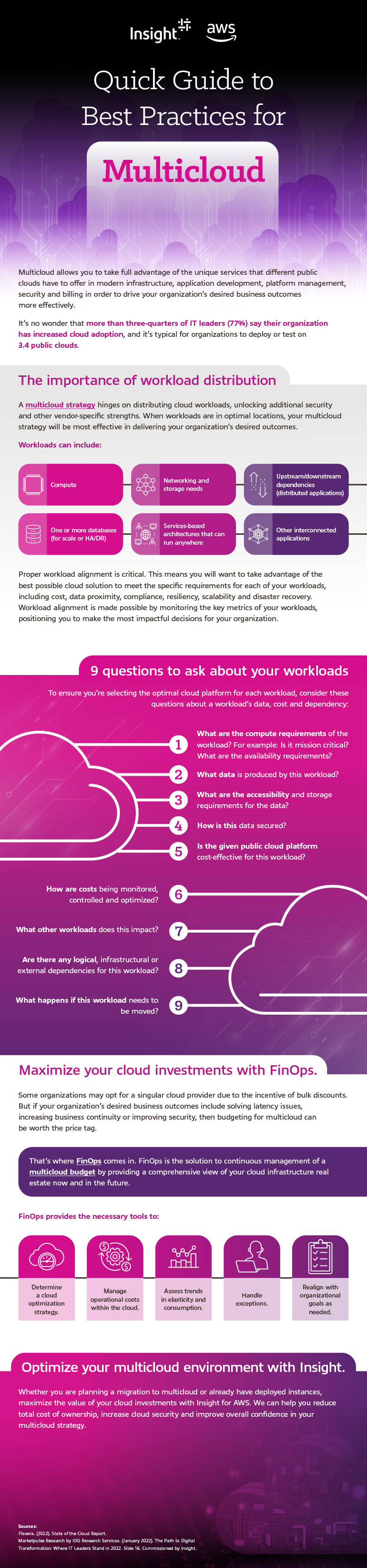
Multicloud allows you to take full advantage of the unique services that different public clouds have to offer in modern infrastructure, application development, platform management, security and billing in order to drive your organization’s desired business outcomes more effectively.
It’s no wonder that more than three-quarters of IT leaders (77%) say their organization has increased cloud adoption, and it’s typical for organizations to deploy or test on 3.4 public clouds.
The importance of workload distribution
A multicloud strategy hinges on distributing cloud workloads, unlocking additional security and other vendor-specific strengths. When workloads are in optimal locations, your multicloud strategy will be most effective in delivering your organization’s desired outcomes.
Workloads can include:
- Compute
- Networking and storage needs
- Upstream/downstream dependencies (distributed applications)
- One or more databases (for scale or HA/DR)
- Services-based architectures that can run anywhere
- Other interconnected applications
Proper workload alignment is critical. This means you will want to take advantage of the best possible cloud solution to meet the specific requirements for each of your workloads,
including cost, data proximity, compliance, resiliency, scalability and disaster recovery.
Workload alignment is made possible by monitoring the key metrics of your workloads,
positioning you to make the most impactful decisions for your organization.
9 questions to ask about your workloads
To ensure you’re selecting the optimal cloud platform for each workload, consider these
questions about a workload’s data, cost and dependency:
- What are the compute requirements of the workload? For example: Is it mission critical? What are the availability requirements?
- What data is produced by this workload?
- What are the accessibility and storage requirements for the data?
- How is this data secured?
- Is the given public cloud platform cost-effective for this workload?
- How are costs being monitored, controlled and optimized?
- What other workloads does this impact?
- Are there any logical, infrastructural or external dependencies for this workload?
- What happens if this workload needs to be moved?
Maximize your cloud investments with FinOps.
Some organizations may opt for a singular cloud provider due to the incentive of bulk discounts. But if your organization’s desired business outcomes include solving latency issues, increasing business continuity or improving security, then budgeting for multicloud can be worth the price tag.
That’s where FinOps comes in. FinOps is the solution to continuous management of a
multicloud budget by providing a comprehensive view of your cloud infrastructure real
estate now and in the future.
FinOps provides the necessary tools to:
- Determine a cloud optimization strategy.
- Manage operational costs within the cloud.
- Assess trends in elasticity and consumption.
- Handle exceptions.
- Realign with organizational goals as needed.
Optimize your multicloud environment with Insight.
Whether you are planning a migration to multicloud or already have deployed instances,
maximize the value of your cloud investments with Insight for AWS. We can help you reduce total cost of ownership, increase cloud security and improve overall confidence in your multicloud strategy.
Sources:
Flexera. (2022). State of the Cloud Report.
Marketpulse Research by IDG Research Services. (January 2022). The Path to Digital
Transformation: Where IT Leaders Stand in 2022. Slide 16. Commissioned by Insight.