Blog Employee Intranet Portal
Over the years, I've been fortunate enough to talk to numerous Human Resources (HR) and corporate communications professionals about the role technology plays in communication, engagement and collaboration. Often, the conversations are very specific — for example, how enterprise social technologies such as Yammer may help support a recent merger and acquisition, or how a 50,000-employee company manages the organizational change required to adopt a new collaboration strategy.
By Brandon Ebken / 11 Jul 2014 / Topics: Microsoft 365 , Modern workplace

I've facilitated, or co-facilitated with Microsoft, several executive-level briefings with HR leaders to discuss the role and best-practice characteristics of the modern employee portal. By the way, these strategy briefings are available to both large and small organizations.
As an IT professional, I try not to insult an audience of HR leaders by proclaiming every action their organization should take. Instead, I prefer to facilitate a discussion concentrated on as many customer stories as possible. In some respects, every organization is different, yet every organization is the same.
I find it interesting to set high-level context and some general observations but back it up with as many anecdotal stories as possible. After all, I don’t believe there's one way to solve a problem and, ultimately, each organization has slightly different goals or objectives. Still, each story speaks for itself and sheds light on how organizations are addressing the challenges. This is generally where the most interesting discussion occurs.
Challenges HR is facing today
The old cliché is your people are your most important asset. There are different variations of this cliché, but in general, everyone agrees organizations that have the best people far outperform their peers. Executives have recognized the importance of the people systems in order to drive sustained growth, increased profitability and happy customers. Without great employees, and a culture to build great employees, sustained business returns aren't possible. As a result, the HR organization continues to play a critical role in the organization — not only with acquiring the best people but, more importantly, developing the talent.
HR leaders recognize that central to talent development is establishing a corporate culture that engages employees, develops leaders, drives innovation and empowers employees to work collaboratively. The modern employee portal is a key component of this strategy.
Historically, the organization’s intranet has represented the employee portal. The challenge with the historic intranet is that it represents a one-way communication from the organization to the employee.
HR or corporate communications professionals generated content, worked with IT to publish the content and made information available for consumption. The problem with this approach was that publishing content was very time-consuming, intranets frequently became stale or out of date and employees weren't able to engage. The intranet never became a digital hub for the organization but instead became an afterthought or a place where “content went to die." This happened for both large and smaller organizations.
Characteristics of the modern employee portal
The modern employee portal/intranet isn't simply a one-way communication tool. At its best, the portal acts as a digital hub where individuals “do work." As a result, we see the modern employee portal enabling productivity and helping emphasize corporate culture through three dimensions: collaboration, engagement and innovation. Thanks to our Microsoft friends for the help in collating these ideas:
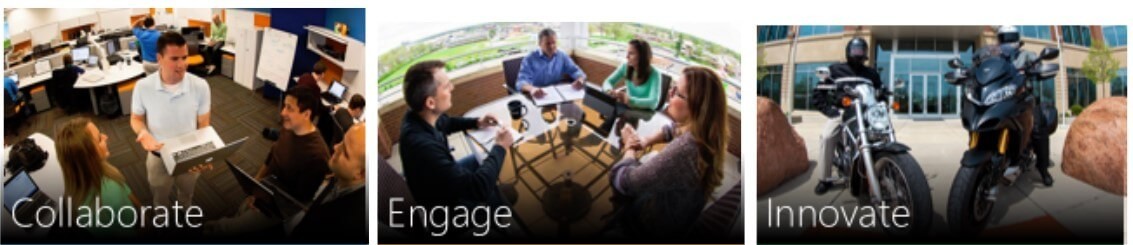
- Collaborate — The modern employee portal provides a place where all individuals go to find information, to find experts, to ask questions and to receive answers. As opposed to generating duplicate work, individuals can locate project artifacts or individual experts. Department, project and team sites are all tightly integrated and searchable.
- Engage — The modern employee portal provides an easy way for content to be published, without the need for IT intervention. Further, the portal enables two-way communication, allowing individuals to not only listen, but also to participate in conversations.
- Innovate — Ultimately, the modern employee portal allows products/projects to be produced quicker and cheaper and with higher quality and business impact. Many organizations realize the best ideas come from the frontline workers and often struggle to empower those workers. The modern portal allows rapid innovation and often includes mechanisms to collaborate and engage between customers and business partners.
Approaches to the modern employee portal
Organizations typically take one of three general approaches to the modern employee portal: a traditional, a social intranet or an app-centric approach. Although I have a personal bias toward a more social approach, I typically use the National Parks metaphor to temper my bias.
Each approach has its own beauty, and each approach can certainly be someone’s favorite. Most importantly, each approach contains mechanisms to solve the collaboration, engagement and innovation challenges. Although the more progressive approaches capitalize on the social aspects, I recognize some organizations are reluctant to go all in initially and start with a more traditional approach.

- Traditional — This is the intranet most organizations are familiar with. It includes content published and largely maintained by HR/corporate communications. Modern tools such as SharePoint make content authoring and publishing a simple task that doesn't require IT intervention. Out of the box, web 2.0 features such as blogs, comments, likes and subscriptions enable two-way engagement. Department, project and team sites are tightly integrated for collaboration.
- Social intranet — The social intranet brings an entire new level of engagement within an enterprise. Some equate the social intranet to adding Facebook-like activity feeds to the traditional intranet, although this is a dangerous comparison when one thinks of all the non-productive content posted to consumer-based social networks. From a tool perspective, Microsoft has since purchased and integrated Yammer, making it the preferred solution with SharePoint.
- App-centric — A new paradigm has gained popularity, especially within larger enterprises. Organizations construct a portfolio of self-service applications that employees configure based on their individual needs. The applications may include corporate news, Yammer, time and expenses, conference room locators, project sites, business process workflows, etc. Users configure the applications through an internal, browser-based app store.
Getting started
About half of the small organizations (less than 200 employees) I've worked with don't have an employee portal at all. All large enterprises have an established intranet, but only about half feel it's driving the expected business value. At Insight, we recommend an agile, user-centric approach. After some upfront planning and user experience design, content is developed and reviewed iteratively, ensuring the solution meets the overall business objectives. Further, the approach is easily enhanced to include organizational change and adoption techniques required to support enterprise social (not shown in the picture below).
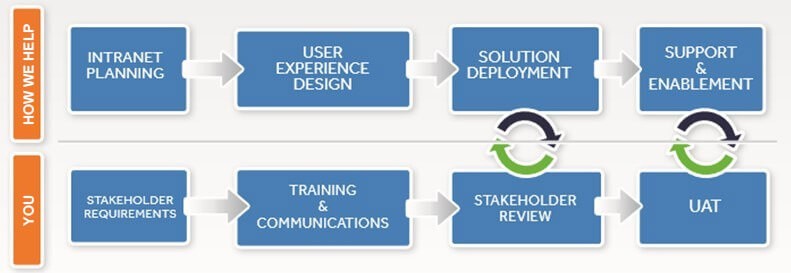
Deploying an intranet/employee portal used to be a several-months initiative, which is why many smaller organizations are yet to establish one. The good news is cloud-based approaches have greatly simplified the technology steps and infrastructure requirements to get started. The cloud has basically leveled the playing field between large enterprises and small to medium businesses.
Through Microsoft Office 365, we can bring a best-in-class employee portal to our clients in a matter of weeks, without significant upfront capital infrastructure investment. Further, Office 365 provides an integrated productivity suite for the entire organization covering messaging, communications, collaboration, social aspects and Microsoft Office products.

Brandon Ebken
Former Chief Technology Officer (2018–2021), Insight
Brandon focused on strategic delivery efforts and new technology initiatives for Insight. He spent most of his days developing solution capabilities and educating clients on the business value of IT offerings and best practices.
 Monthly perspectives from global tech leaders.