Article Strategic Outlook: Why 2026 is the Year AI Moves From R&D to ROI
By Insight Editor / 21 Feb 2026 / Topics: Artificial Intelligence (AI) , Generative AI , Digital transformation

Key takeaways
- Shift to agentic systems: Value is moving from specific models to specialized AI agents and architectural orchestration.
- Focus on profitability: Leadership is shortening ROI windows and optimizing model usage for cost efficiency.
- Service as Software: Organizations are automating job functions and unifying interfaces to reduce toil.
- Audience of one: Users now demand hyper-personalized, frictionless interfaces that adapt in real time.
The experimentation phase of generative AI is ending. Discover why 2026 is the year organizations shift focus from possibility to performance and profitability.
As the initial wave of generative AI hype settles, a new reality is setting in for the C-suite. The experimentation phase of 2024 and 2025 is rapidly giving way to a more disciplined, outcome-oriented era.
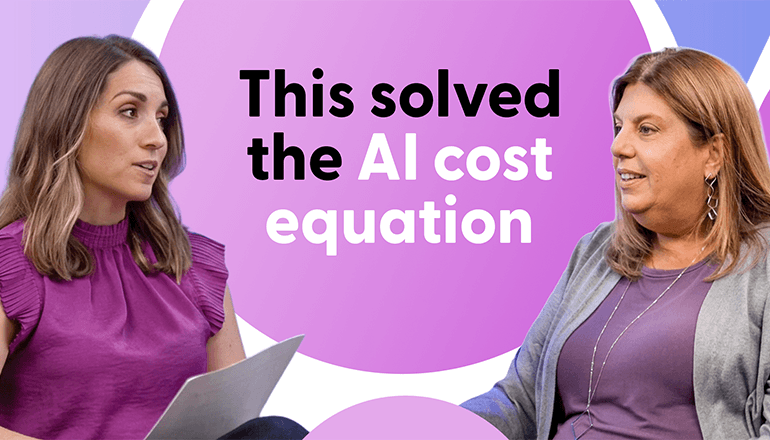
Recently, two of Insight’s leading experts—Miles Ward, CTO of AI in Solution Lines, and Simon Margolis, Associate CTO, AI & ML—sat down to synthesize the current shifts they are seeing across thousands of customer engagements. Their conclusion? 2026 will be the year of profitable AI, where the focus shifts from what is possible to what is performant.
Here are the four pillars of their strategic outlook for the next year.
1. The abstraction of the "model layer"

We are moving past the era of "model obsession." Just as developers today don't ask about the specific instruction set of a CPU before building an app, business leaders will stop focusing on which specific LLM they are using.
The value in 2026 lies in agentic systems—specialized AI agents that communicate through Managed Context Protocols (MCP). The expertise is shifting from prompt engineering to architectural orchestration. Leaders should stop asking "Which model is best?" and start asking "Which system architecture delivers the outcome with the least amount of friction?"
2. Closing the "R&D bucket

For the past two years, boards have tolerated AI spend as a line item in the R&D budget. That patience is thinning.
- Quarterly returns: Executive leadership is shrinking the window for ROI from years to quarters.
- Model optimization: There is a massive financial delta between models. For example, the output tokens for a top-line model like Gemini 3 Pro are 25 times more expensive than the high-speed Gemini 3 Flash.
- The profitability pivot: 2026 will reward the "savvier" organizations that use high-intelligence models for logic and reasoning, but swap in distilled, cost-efficient models for high-volume tasks like summarization.
3. "Service as Software": Redefining the org chart
One of the experts’ most provocative insights was the concept of "inhuman resources." Rather than looking at AI as a tool, sophisticated organizations are looking at AI as a way to perform the functions of a role.
The goal is to transition from Software as a Service (SaaS) to Service as Software.
- Functional decomposition: Breaking down a job description into its 100+ component tasks and automating the high-volume "toil" using tools like Gemini Enterprise.
- Tool compression: Instead of employees toggling between seven different systems (CRM, ERP, Billing, etc.), organizations are building unified agentic interfaces that pull data from everywhere into a single, actionable conversation.
4. The luxury trap and the audience of one

In technology, a "luxury trap" occurs when a new level of ease becomes so standard that the previous version feels broken.
Consumers and employees alike will no longer accept "v1" AI bots that only follow five pre-set routes. In 2026, the expectation is an "audience of one" experience. This means user interfaces and workflows that adapt to the specific accent, language, data density, and interaction style of the individual user in real-time. If your interface isn't frictionless, your customer will assume your technology is obsolete.
Summary: The arrow of innovation
The rate of change is not slowing; it is compounding. What was considered science fiction eighteen months ago is now becoming a contractual obligation. In 2026, the mandate for leadership is clear: stop treating AI as a separate innovation project and start wiring it into the foundational machinery of how your business delivers value.
Ready to build your own "inhuman resources" department?
The transition from experimental AI to profitable agentic systems requires a clear roadmap. To help you move from strategy to implementation, download The AI Agent Handbook. Inside this guide, you’ll discover:
- How to use Gemini and Vertex AI to automate complex enterprise workflows.
- Practical applications for streamlining HR, customer service, and data analysis.
- A blueprint for integrating AI agents with your existing enterprise data.
Download the guide: Ready to build your own "inhuman resources" department? Download The AI Agent Handbook to move from strategy to implementation.
 Monthly perspectives from global tech leaders.