Article Spatial AI Is Taking AI Out of Chatbots and Into the Real World
By Tre Powers / 28 Jul 2026 / Topics: Artificial Intelligence (AI) , Devices
Key takeaways
- Spatial AI extends generative AI into three-dimensional environments, enabling organizations to move beyond text, images, and video to immersive, interactive experiences powered by spatial computing.
- Enterprise use cases for spatial AI are already emerging, including remote assistance, guided workflows, workforce training, healthcare applications, and real-time operational support.
- Generative spaces and immersive technology are becoming more practical as AI-powered wearables, holographic interfaces, and digital twins create new ways for employees to interact with information and physical environments.
- Organizations should incorporate spatial AI into their AI strategy today, as advances in AI wearables, hybrid AI architectures, and connected digital experiences continue to accelerate enterprise adoption.
For the past few years, generative AI has been the technology world’s biggest headline, drawing attention while other innovations waited in the wings.
Now, a new act is stepping into the spotlight. Spatial AI is bringing intelligence out of chat windows and into the physical world, creating immersive experiences that could fundamentally change how people work, learn, and interact with information.
For IT leaders who last checked in during the XR craze, the pace can be disorienting. So, we sat down with Matt Fedorovich, a Senior Architect at Insight, to separate what’s real from what’s marketing — and to explain, in plain terms, what “spatial AI” and “generative spaces” actually mean for the enterprise.
Tre Powers: Let’s start by defining spatial AI and generative spaces. What are they, what are the benefits, and how do they differ?
Matt Fedorovich: Spatial AI evolves how we interact with technology by moving from flat screens into 3D environments. Think of it as an immersion-to-dimension scale:
- The Evolution: We went from typing prompts for text responses, to generating images and videos, and now to prompting full 3D assets and AI-powered avatars.
- Generative Spaces: Instead of just looking at AI, you can step inside it. You can prompt an AI to build a 3D world, live inside that world, or interact with objects and environments that are actively powered by AI.
Ultimately, Spatial AI is the intersection of these two. It’s the experience of being inside a generative 3D space and interacting with the AI around you.
You mentioned an immersion-to-dimension chart — generative AI moving from 2D to 3D. Where are we on that curve today, and what does the future look like?
Two or three years ago, we pretty much stopped at the avatar stage. These days we’re way past that. We have tools from partners like Google and NVIDIA where you can prompt to build an entire hospital in 3D or any other use case. That technology has already been built. The real-world use cases will be applied and tried very soon.
When you talk to people about spatial AI and spatial computing, does everyone have a realistic expectation of it, or do you have to reset what’s possible?
It’s a bit of a reset. People tend to think it’s whatever has been marketed to them from a consumer standpoint. Some hardware partners like to promote the consumer angle — “just talk to your glasses, talk to your headset” — but they don’t go deeper into the spatial AI use cases.
Take remote assist, which has been one of our biggest-selling solutions for the past 10 years. It always required a human on both ends: you’d call someone on Teams, they’d see what you see, and you’d work together. With spatial AI, you can streamline the process and get faster access to information.
There is a learning curve, and it’ll keep growing as the technology branches into new areas. With all the new AI glasses and wearables coming, it won’t just be audio and cameras. We’re going to start talking about displays and holographic interfaces again. It keeps splintering off, but it’s always going to be a reset of where we are.
What are some of the use cases for spatial AI you can think of right now for organizations?
There are a ton of use cases that can be developed right now. The biggest hurdle isn’t technology. It’s helping companies understand what AI can do for them in general, and working through privacy, security, and governance questions. Those are the things we iron out with clients.
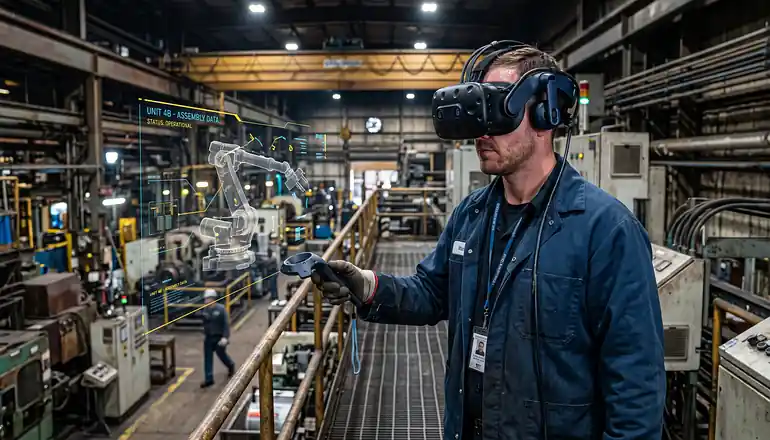
As for specific use cases, there are so many, and there will be more as AI glasses and wearables mature. Remote assist is one. Guided workflow is another. It gives you step-by-step instructions verified directly on your wearable, because it sees what you see. As you work, it verifies your work.
As more display-based and holographic devices come back into the fold, we’ll start talking about patient data inside a private wearable at a hospital. Or walking around a building while AI feeds you information about what you’re looking at. And in VR, because we can add AI to 3D content, your training and everything you do in that space will likely be monitored or powered by some kind of AI. It’s already being built. Look at AAA gaming, where the NPCs are all powered by some form of machine learning or AI.
You’ve mentioned manufacturing and healthcare. Which other industries should be paying attention to spatial AI right now?
Manufacturing and healthcare seem to be the biggest, but education and defense are the next closest industries. The defense sector is absolutely blowing up with this right now, for things like real-time warfighter support and training ops. That translates into public safety and local law enforcement too; they’re already using body cameras with AI built in. That’s a different kind of wearable, but it’s using spatial AI to do some understanding of the world.
VR-trained participants showed 3.75x more emotional connection to training content and up to 275% more confidence in applying newly-acquired skills.1
After that, I’d lean into retail. This technology can be used for store layouts, understanding which brand goes where, pick-pack-and-ship for online orders. There are really two sides: the back-of-store side, inventory and stock, and the customer-facing side.
Where does Insight fit? What can you deliver that another vendor can’t?
Recently, I had to pitch to healthcare and industry leads, and they asked me the same question. My initial answer was that we do everything, end to end. Then I broke it down.
We’re the only company I’ve seen that can provide the hardware, the setup, provisioning, and supply-chain services, the integration with third-party, first-party, or OEM solutions, device management, sustainability services like break-fix and fleet management; and custom application development in a consultative approach. So, whatever a company needs for spatial, they can come to Insight for it.
How do Insight’s partnerships affect what you’re able to build?
A lot. That’s why we stay close to all our hardware OEM partners — they bring in new devices and sunset old ones constantly, so we always need a game plan for clients when that happens. When Microsoft HoloLens was discontinued, a lot of clients came back asking, “What do we do now? How do I transition?” There wasn’t an obvious answer, which put us in a bit of a vacuum, but it also created a lot of conversations.
Much of what we do hinges on what the partners do on the hardware side. If they build hardware that doesn’t support what we support, we can’t build for it. Meta originally had no device management, so we couldn’t offer Modern Device Management (MDM) or even run those devices through our labs easily. Clients wanted them anyway, so Meta had to pivot. The cycle is: an OEM builds a product the way they think it should work, puts it in the market, we collect client feedback, and then the OEM conforms to enterprise needs in the next generation or a software update. It’s not ideal, but our partners are learning more about the challenges of enterprise technology.
As generative AI makes the jump to fully 3D, what does the everyday workplace or customer experience look like in three to five years?
It comes down to those branching components. Consumers are adopting AI wearables — Meta Ray-Bans, Samsung’s headsets — the same way they adopted mobile, which is exactly how mobile made its way into the enterprise. As Meta, Samsung, and Apple build smaller, faster, smarter wearables with AI built directly onto them, you’ll see that same BYOD model come to the workplace across a ton of industries.
The wearables will become an extension of your mobile device, just like your smartwatch is today. If your glasses connect to your phone — which has more processing power, longer battery life, and the security and privacy controls tied to your workplace — those personal devices become an extension of your phone. That wasn’t the initial vision, because the OEMs wanted to sell glasses as a brand-new platform, but they’re all working on direct integration with your personal device now.
Whether it’s a BYOD enterprise device, one you connect to at a hospital, or glasses that tether to a workstation in automotive manufacturing, it all connects back to a main hub.
So the future of immersive technology is building out more branches and connections of this tech similar to Apple’s ecosystem across its devices?
Essentially, yes.
The other big shift, and I’m seeing these conversations happen right now, is toward on-device AI, cloud AI, and even hybrid AI. Cloud AI can get expensive fast. We went through this exact thing with cloud compute: everyone freaked out about the cost, and we had to offload some of it back to the user’s device. The same thing is going to happen with AI — reducing consumption by moving some of the processing on-device, with a hybrid approach that keeps costs down and connects devices to a company’s own knowledge base rather than always calling out to an external, paid AI service.
If someone takes away only one thing about spatial AI and generative spaces, what should it be?
That it’s here and now. The use cases are real. They’re not smoke and mirrors. Better devices for these use cases are coming; a lot of our clients have been asking when, and how much smaller and more capable they’ll get. There’s a lot more of that arriving next year. And I’d say: keep working on your AI strategy, because these devices are absolutely going to integrate with the strategy you build for your company.
Reimagine how work gets done. Insight delivers a variety of digital workplace solutions that help employees collaborate, learn, and work smarter.
1 Torrendell, H. (2026, April 13). Spatial Computing Industry Statistics Report 2026. Treeview.
About the author:

Tre Powers
Senior Content Strategist, Insight
Tre Powers is a Senior Content Strategist at Insight who believes technology content should be as impactful as the innovations behind it. Tre leverages over 8 years of marketing experience to write about AI, digital workplace transformation, devices, and enterprise technology to help IT leaders cut through the buzzwords and focus on what drives meaningful business outcomes.
 Monthly perspectives from global tech leaders.