Article Smarter, Faster, Safer: How AI Strengthens Response in Public Safety Contact Centers
By Insight Editor / 18 Aug 2026 / Topics: Artificial Intelligence (AI) , Automation , Customer experience

Key takeaways
- AI can manage routine, non-emergency, and duplicate interactions so dispatchers can focus on incidents requiring professional judgment.
- Connecting cameras, incident feeds, CAD, and RMS data gives responders better situational awareness before they arrive on scene.
- A focused AI pilot allows agencies to build confidence and expand AI capabilities responsibly.
One emergency, dozens of calls — how can dispatchers capture information while keeping responders in the loop? It’s an overwhelming responsibility that could be aided by the latest AI capabilities. With connected data and automated workflows, AI can support the dispatch team in guiding a faster, safer, and more informed response.
Large emergencies can quickly wear on an overburdened workforce. According to the 2025 Pulse of 9-1-1 report, staff burnout was the top reported issue facing Emergency Communications Centers (ECCs), followed by understaffing.
Public safety contact centers receive high volumes of information from a variety of sources. Not every interaction requires the same response, but each call must be handled with the same amount of care and diligence. When information is fragmented in silos across conversations, systems, and feeds, dispatchers must spend valuable time piecing together the details before they can trigger an action.
AI can aid emergency response by freeing up dispatchers to focus on critical calls that require a human touch, while also collecting and organizing details for responders.
Use AI to prioritize contact center response
Legacy technology that focuses strictly on call routing and recording won’t keep up with rising call volumes or ease the dispatcher’s workload. AI-enabled tools can reduce the burden by assisting with repetitive tasks so operators can focus on situations where human judgment is essential.
AI use cases for public safety agencies:
- Non-emergency call deflection – Directing non-emergency requests to the correct department
- Call prioritization – Collecting context to help identify more emergent situations.
- Duplicate incident detection – Recognizing when multiple callers appear to report the same event.
- Automated incident updates – Providing known information to callers without requiring a dispatcher to repeat it.
- Voice-to-text transcription – Capturing conversations in real time to reduce manual notetaking.
Connect data to deliver situational awareness
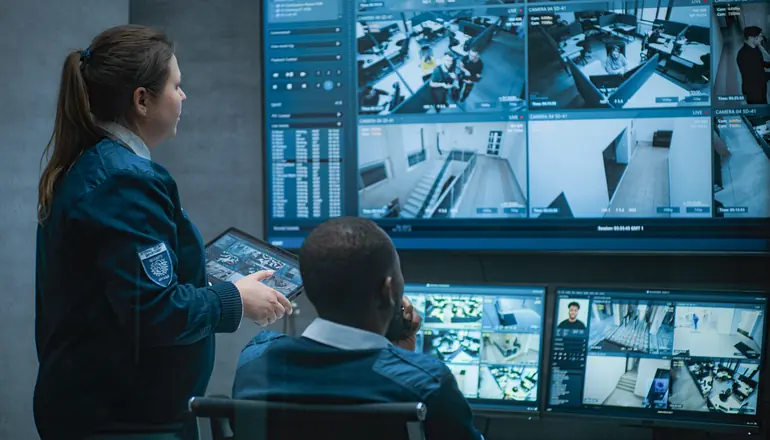
The public safety contact center must be able to collect, organize, and share critical details with responders to give them situational context before arriving on the scene of an emergency. These details could include:
- Location
- Number of involved
- Injury descriptions
- Status of criminal subjects
- Traffic concerns
With a modern command center design, details can be gathered from a variety of sources, including:
- Body camera video
- City or traffic cameras
- Sensor alerts
- Photos or videos submitted by witnesses
- Emergency calls
- Incident feeds
Services such as Amazon Connect and Contact Lens turn calls into searchable transcripts, summaries, and insights. When connected with an existing Computer-Aided Dispatch (CAD), telephony, and Records Management Systems (RMS), agencies can deliver a more complete view of any incident.
Improved situational awareness helps responders select the quickest route, prepare for known risks, request backup, and collaborate more effectively across agencies.

A thoughtful path toward modernization
Integrating AI into any critical workflow requires planning and strategic insight. Agencies should not be in a rush to integrate AI, but rather should consider starting small with an AI pilot applied to one use case. This could be adding post-call analytics to a non-emergency queue, introducing AI-assisted QA for a subset of calls, or deploying keyword-based alerts for critical incidents.
Insight Public Sector can help you design a pilot that leverages best practices to build internal confidence and deliver success. Then, Insight can guide further research and exploration of how AI and AWS can be used to strengthen other areas of the emergency response.
Together, we can design a roadmap that modernizes the public safety call center with AI responsibly, while protecting your people and citizens.
 Monthly perspectives from global tech leaders.