Blog How to Teach Clients to Fish With AI; and Other Lessons We’ve Learned From Insight CEO Joyce Mullen
By Miles Ward / 3 Mar 2026 / Topics: Artificial Intelligence (AI) , Solutions Integrator , Generative AI , Digital transformation

After more than five years of driving Insight Enterprises’ evolution into the leading Solutions Integrator, our CEO Joyce Mullen is setting off on her next chapter. She’s leaving behind a legacy that didn’t just change our org chart — it fundamentally changed our speed.
Under her leadership, Insight treated AI as a mandate, not a novelty. Joyce worked upstream from the challenge, providing the tools and the training required to actually do the work, making the same commitment herself through hands-on upskilling. As Insight continues to lead the way in AI innovation, we’re applying what we’ve learned as “client zero” to help our clients close the gap between AI hype and profitable business outcomes.
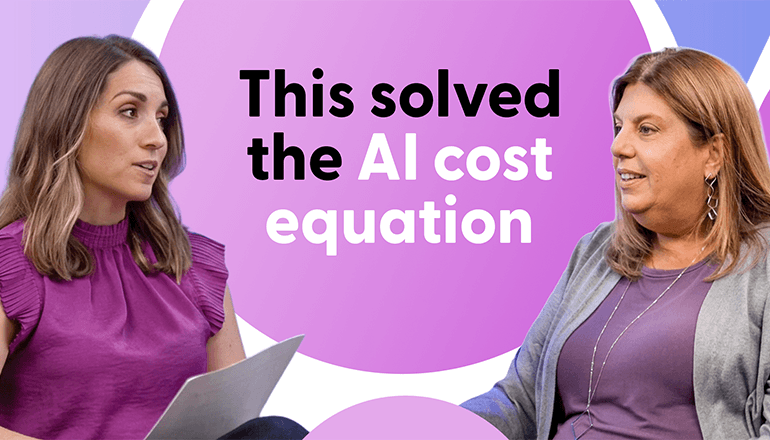
As Insight CTO for AI in solution lines, I’ve only had the pleasure of working with Joyce for part of her tenure, but her impact on how we operate is unmistakable. In a recent conversation about the direction of the company and future of the industry, she shared the philosophy that shaped her time here.

Hunger, Heart, Harmony, and HugOps
I found Joyce’s approach to technology intensely human. For example, under her leadership, Insight chose to adopt AI early so we could learn the hard way, make the mistakes ourselves, and spare our clients the fallout of those early missteps. That mindset reinforces our commitment to client success, driven by our corporate values of Hunger, Heart, and Harmony.
Joyce believes the success stories that resonate the most are the ones where Insight helps clients through an especially tough time, like the client who literally hugged a teammate after they helped resolve a security breach.
That philosophy perfectly matches my own approach to engineering. When we helped clients navigate outages last year, I encouraged our engineers to embrace what the internet calls “HugOps.” It's not just DevOps, anymore. In high-pressure moments, technical infrastructure matters, but so does empathy. If you can't hug each other through the operational toil of bringing a mission-critical system back online, what can you do?
In the end, Hunger, Heart, and Harmony aren’t just values on a wall. They show up in how we learn, how we fail, and how we show up for clients when they need us the most. In a world where so much of how we work is changing, these values help make progress possible.
The Satya Room vs. the Harvard Room
Inside Insight, the momentum around AI is everywhere. Joyce didn’t just give us permission to use these tools, she gave us a mandate. Now, leaders across finance, marketing, and human resources are actively demanding ways to move forward. But when I meet with clients, the reality is often different. Many are still stuck in the experimentation phase, deciding if they should move forward at all.
That gap isn’t a problem. It’s our purpose.
As Joyce put it in our conversation, we can't be the leading Solutions Integrator in an AI-first world if we don't walk the walk. She recalled seeing this industry gap play out in real time a couple of years ago. At one meeting hosted by Microsoft’s Satya Nadella, 150 tech CEOs were energized by the possibilities of AI and eager to get started. Weeks later, at an event at Harvard Business School, 40 enterprise leaders voiced intense skepticism. Citing security fears, they wanted to ban the tools outright.
Joyce saw the first group as our partners and the second group as our clients. That stark contrast reinforced our mandate: As a Solutions Integrator, we have to provide the governance and security so our clients have the confidence to run fast. It’s why we invested heavily in programs like our internal Insight AI Flight Academy to drive teammate adoption. And why we use tools like Prism to help clients move from vague ideas to measurable ROI in weeks, not months. As Joyce often says, we aren’t there to hand them a fish; We’re here to teach them to fish in the AI era.
The Ultimate Leadership Lesson: Paint the Bathrooms
Ultimately, you can’t lead a massive technological transformation with a spreadsheet. You do it by earning trust. That philosophy ties back to what Joyce calls her No. 1 lesson in leadership, one she learned early in her career as a plant manager: Paint the bathrooms.
When she stepped into the role, the manufacturing facility was running fine, but the bathrooms were a disaster — broken mirrors, peeling paint, total neglect. Because the frontline employees had to use them every day, that neglect sent a loud message about their worth. So, Joyce found the budget and painted the bathrooms. It wasn’t about aesthetics; It was about proving that the people doing the daily work mattered.
In the AI era, painting the bathrooms means fixing the broken, soul-sucking workflows that make your employees miserable. It means automating the spreadsheet layer of manual data entry so your team can focus on high-value work.
Progress starts with understanding what your teammates care about, lining up their objectives with your own, and giving them the tools to succeed. That mindset is the true core of Joyce’s legacy. It’s how we operate today. And it’s the exact energy we bring to every client we serve.

Miles Ward
Chief Technology Officer of AI Innovation, Insight
As Chief Technology Officer of AI Innovation at Insight, Miles drives AI acceleration across Insight's services portfolio. His remit includes bringing together the company's AI capabilities to deliver differentiated outcomes for clients such as BlackLine and Viiz Communications; reinforcing Insight's engineering culture; and engaging with customers on their most complex and ambitious AI initiatives.