Article Software as a Service (SaaS) Benefits for Small Business
Software as a service (SaaS) is rapidly crossing over to the small and medium business sector while flying under the banner of a subscription model.
By Michael Lazar / 22 Sep 2016 / Topics: As a service , Cloud , Software

The business model for IT delivered as a service has greatly changed throughout the past decade.
In the early ‘90s, businesses had to buy a software license from a corporate provider, usually at a high aggregate cost. These one-time licenses were required for each computer node running the software. Additionally, most software publishers charged a yearly maintenance fee. Larger businesses were required to purchase costly enterprise-level license packages. Every couple of years, the software creator issued the newest version, and the cycle repeated.
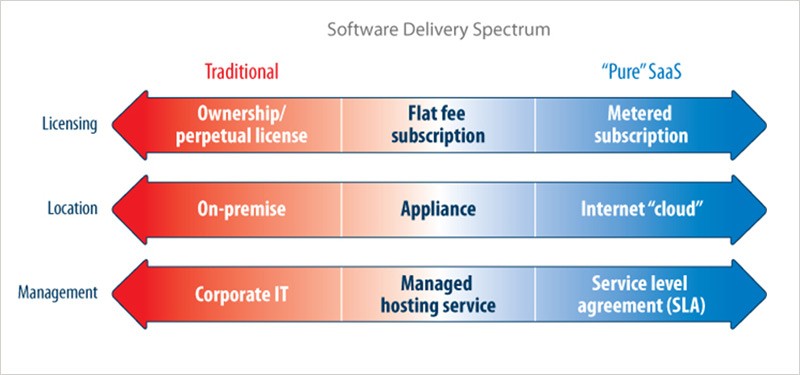
The SaaS model is quickly changing how organizations access their software tools — creating huge opportunities for small businesses that weren’t always available through the previous model.
What is Software as a Service (SaaS)?
Let’s start with the basics. Software as a Serivce, or commonly referred to as SaaS, is a licensing and distribution model where the software publishers host applications for clients to use. An internet connection is often required and small businesses have the option to scale their software usage up or down easily and pay for exactly what they need.
Software as a Service: The new subscription model
Newer approaches to SaaS solutions (or XaaS solutions) are doing away with the costly per-user license model of yesteryear. Instead, software makers have learned a valuable lesson from the music industry, which saw CDs and brick-and-mortar record stores reduced to rubble during the digital web 2.0 boom, making way for iTunes. Much like Blockbuster was replaced by Netflix, the SaaS model replaced individual or enterprise licenses.
“With the advent of the cloud, things are very reasonably priced, and you pay for software on a consumption basis. So what it’s really doing is enabling small businesses to look like large businesses more than they ever could. ... So you’re seeing another complete evolution where now they can get big data analytics at reasonable prices, which only really used to be available to big companies. All the tools they need to run their businesses smarter,” explains Ken Lamneck, CEO of Insight.
There are countless subscription SaaS models out there with an affordable monthly base and plenty of addable options, ranging from cloud-based solutions to SaaS apps.
Now, this Anything as a Service (XaaS) model is dramatically changing an entire industry that has adapted to a newer subscription-based model. With this evolution comes an array of benefits to small and medium business that are simply game-changing. What follows are some candid reasons why.
An even playing field
The reality is that a majority of small businesses lack the budget enterprise-level companies have. The SaaS subscription model helps even the playing field by making business software solutions more affordable and attainable for smaller budgets. With the ability to access major league software solutions, ranging from security and cloud to business management and Customer Relationship Management (CRM), small and medium businesses can more effectively compete with business giants.
Enterprise-level security can be obtained with small business affordability, enabling organizations of all sizes to offer the same security assurance to their customers. In addition, with the right software in place, small and medium businesses can market their products and services with automation and some of the same tools and features as enterprise-level companies. With technology-enhanced marketing options comes revenue generation and the cash flow needed to not only sustain operations, but to invest in more disruptive technology.
Cloud computing and hosting
Not to be overlooked is the newest entrant to the XaaS model: cloud computing. There used to be a barrier of entry to the cloud computing model for small and medium businesses, as this chart from 2011 reflects.
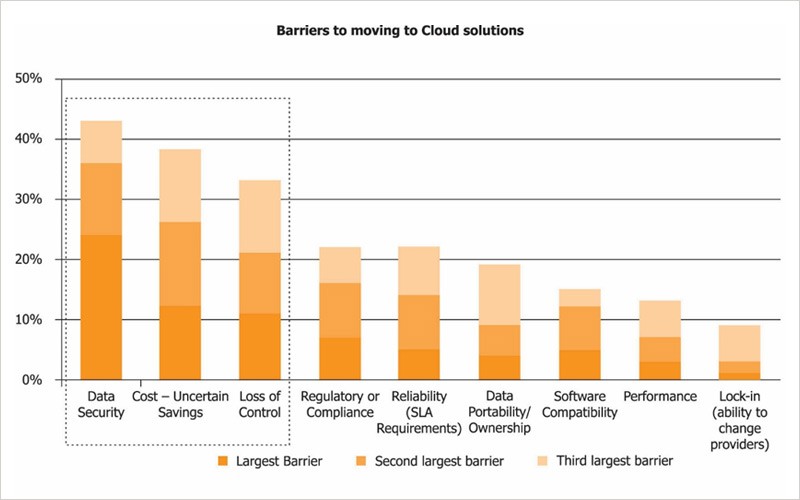
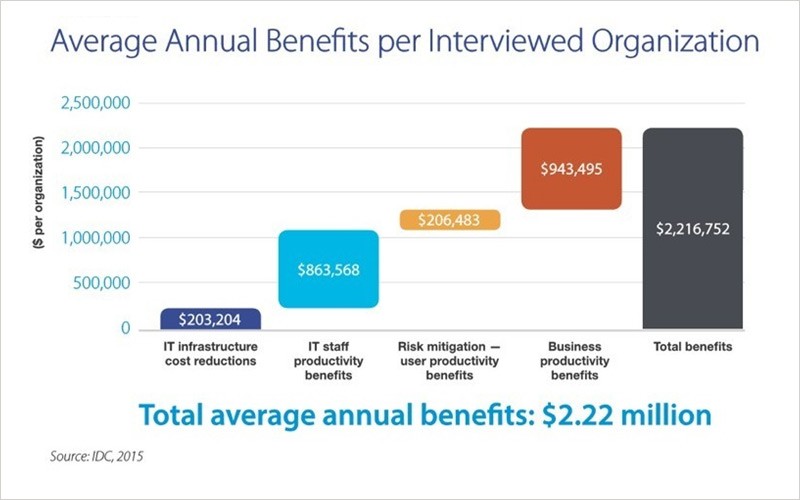
But a quick look at this corresponding 2015 IDC chart tells a different story. Small and medium business no longer face insurmountable cost barriers when moving to the cloud. In fact, migrating to the cloud usually results in cost savings in the forms of IT infrastructure cost reductions, IT staff productivity benefits, risk mitigation and business productivity benefits. Combined, these benefits total an average of $2.2 million per business annually.
Customer relationship management
Last, but certainly not least, is the CRM model. In previous decades, CRM was a glorified Rolodex only large entities could afford. Pricing models weren’t compatible with the small business budget, and that left a wide and rather competitive gap in customer engagement. With larger entities having the upper hand, they were able to continue to grow by nurturing and maturing client relationships. Up until just recently, as in the past decade or so, CRM became a viable option for many smaller businesses.
Today’s SaaS model is an exciting one that’s highly diverse. Its scalable design means businesses of all sizes can get on board. You don’t need deep pockets to compete, just the right team.