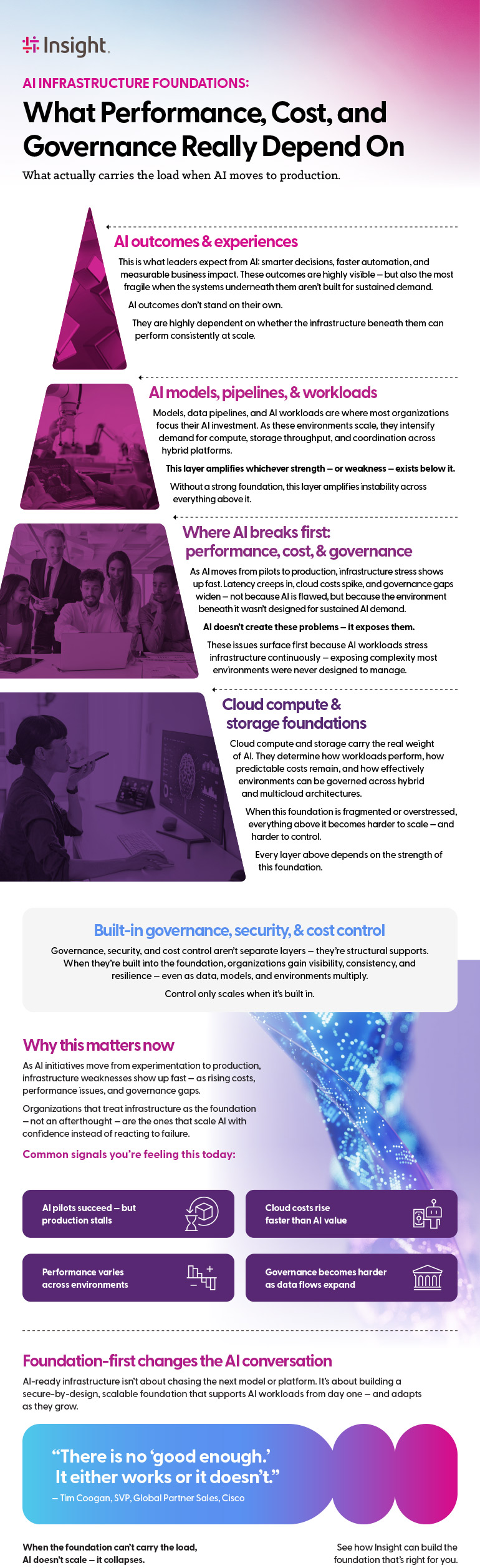
Infographic text included for screen readers:
AI Infrastructure Foundations: What Performance, Cost, and Governance Really Depend On
What actually carries the load when AI moves to production.
AI outcomes & experiences
This is what leaders expect from AI: smarter decisions, faster automation, and measurable business impact. These outcomes are highly visible — but also the most fragile when the systems underneath them aren’t built for sustained demand.
AI outcomes don’t stand on their own.
They are highly dependent on whether the infrastructure beneath them can perform consistently at scale.
AI models, pipelines, & workloads
Models, data pipelines, and AI workloads are where most organizations focus their AI investment. As these environments scale, they intensify demand for compute, storage throughput, and coordination across hybrid platforms.
This layer amplifies whichever strength — or weakness — exists below it.
Without a strong foundation, this layer amplifies instability across everything above it.
Where AI breaks first: performance, cost, & governance
As AI moves from pilots to production, infrastructure stress shows up fast. Latency creeps in, cloud costs spike, and governance gaps widen — not because AI is flawed, but because the environment beneath it wasn’t designed for sustained AI demand.
AI doesn’t create these problems — it exposes them.
These issues surface first because AI workloads stress infrastructure continuously — exposing complexity most environments were never designed to manage.
Cloud compute & storage foundations
Cloud compute and storage carry the real weight of AI. They determine how workloads perform, how predictable costs remain, and how effectively environments can be governed across hybrid and multicloud architectures.
When this foundation is fragmented or overstressed, everything above it becomes harder to scale — and harder to control.
Every layer above depends on the strength of this foundation.
Built-in governance, security, & cost control
Governance, security, and cost control aren’t separate layers — they’re structural supports. When they’re built into the foundation, organizations gain visibility, consistency, and resilience — even as data, models, and environments multiply.
Control only scales when it’s built in.
Why this matters now
As AI initiatives move from experimentation to production, infrastructure weaknesses show up fast — as rising costs, performance issues, and governance gaps.
Organizations that treat infrastructure as the foundation — not an afterthought — are the ones that scale AI with confidence instead of reacting to failure.
Common signals you’re feeling this today:
- AI pilots succeed — but production stalls
- Cloud costs rise faster than AI value
- Performance varies across environments
- Governance becomes harder as data flows expand
Foundation-first changes the AI conversation
AI-ready infrastructure isn’t about chasing the next model or platform. It’s about building a secure-by-design, scalable foundation that supports AI workloads from day one — and adapts as they grow.
“There is no ‘good enough.’ It either works or it doesn’t.” — Tim Coogan, SVP, Global Partner Sales, Cisco
When the foundation can’t carry the load, AI doesn’t scale — it collapses.
See how Insight can build the foundation that’s right for you.