Blog What is a Digital Twin? Understanding the Four Layers
By Matt Fedorovich / 2 Jul 2026 / Topics: Immersive technology , Devices
Key takeaways
- A true digital twin is more than a 3D model. It is a living, continuously synchronized representation of a physical asset, system, or environment.
- Digital twins rely on four core layers: visual, data, interaction, and simulation — and each layer adds distinct value.
- The greatest business value comes when all four layers work together to enable real-time visibility, action, and predictive decision-making.
For many, the term “digital twin” still conjures up a sleek 3D CAD model in their minds. Is it impressive to demo? Sure. But is it ultimately static? Yes. This very misconception is costing real operational value.
What is a digital twin?
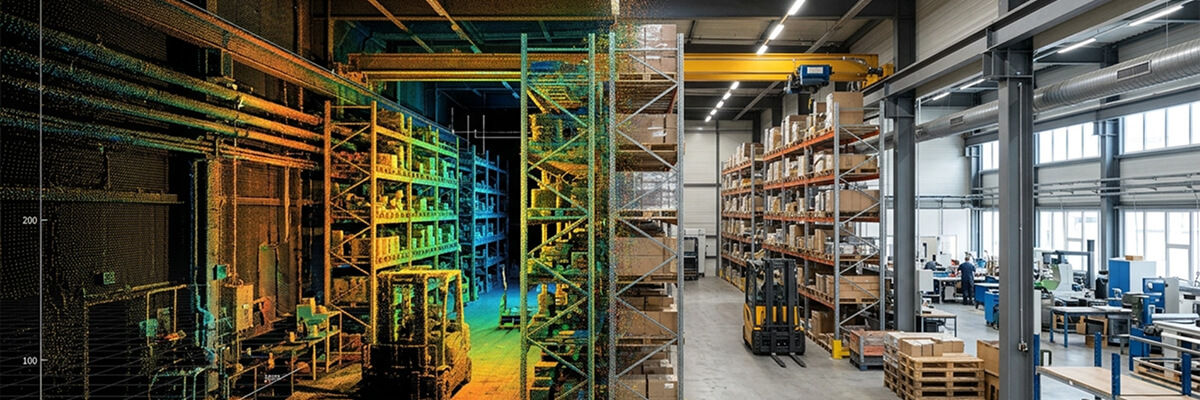
A digital twin is a living, continuously synchronized digital representation of a physical asset, system, or environment. It doesn’t just visualize what something looks like, but it reflects what is happening right now, enables direct interaction, and supports predictive decision-making at scale.
What separates a basic model from a true digital twin comes down to four essential layers, and how together they form its core anatomy.
Examples of digital twins include:
- Retail operations: Major brands build digital twins of retail stores to optimize product placement, plan shelf restocking, and analyze customer movement.
- Healthcare: Care providers and hospitals build digital duplicates of operating rooms to plan and track instrument placement and equipment usage.
- Manufacturing: Automakers and other manufacturers create digital replicas of factory floors to optimize assembly lines.
The four layers of a digital twin
Before breaking down the anatomy of a true digital twin, it helps to clarify what we mean by “layers.”
A digital twin isn’t a single piece of technology. It’s a stack of capabilities that build on one another. The full value of a digital twin comes from how these layers work together as an integrated system.
Each layer adds a distinct function:
- Visual Layer: Seeing assets and conditions in context. The visual layer is where teams orient themselves.
- Data Layer: Connects real-world data. The data layer keeps the twin factual by continually feeding it sensor, system, and historical signals.
- Interaction Layer: Enables action. The interaction layer is where insight turns to action through alerts, workflows, and secure control.
- Simulation Layer: Forecasting outcomes. The simulation layer is where organizations look ahead; testing scenarios and predicting outcomes before they happen in the physical world.
Understanding the visual layer
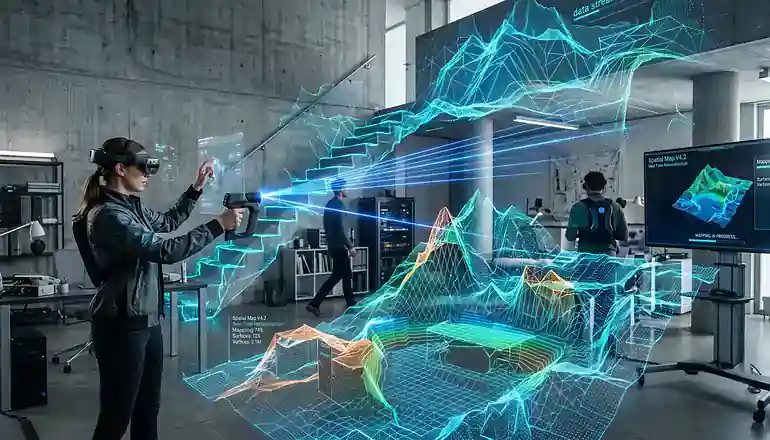
The visual layer or “the face” is what users see and interact with. Its purpose is to make complex operational data spatially meaningful and immediately intuitive.
This layer typically includes 3D renderings, AR/VR interfaces, and GIS-based spatial mapping — the tools that let users see operational data in context rather than parsing it through tables or flat dashboards. A technician shouldn’t have to cross-reference a spreadsheet to understand which asset is failing and where it sits inside a facility. They should be able to see it.
Breaking down the data layer
The visual layer is only animation without data behind it. The data layer, also known as the nervous system, is what connects the physical world to its digital counterpart and keeps that connection current.
This layer encompasses IoT sensors, edge computing, historical data stores, and API integrations with enterprise systems. It collects, normalizes, and synchronizes data so the twin accurately reflects the state of the physical asset at any given moment.
Modern digital twin architectures increasingly rely on edge computing to process data close to the source. This reduces latency and maintains accuracy even in constrained network environments.
Approaching the interaction layer
A digital twin shouldn’t be a one-way mirror. The interaction layer serves as the hands, enabling two-way communication between the digital model and the physical asset it represents.
This layer includes alerting systems, role-based access controls, operational workflows, and remote control capabilities. When conditions shift or anomalies surface, operators can respond directly through the twin interface. No context switching, no delay.
Closed-loop digital twin systems allow teams to move from detection to resolution faster, reducing downtime and operational risk.
Ending on the simulation layer
This is where digital twins deliver their strongest return on investment. The simulation layer, the brain, includes physics-based modeling, AI and machine learning, and what-if scenario testing. Rather than simply showing what is happening now, the twin can simulate future outcomes based on real operational data — forecasting failures, testing configuration changes, optimizing layouts, and evaluating risk before anything changes in the physical world.
Recent advances in AI-accelerated simulation are meaningfully reducing the time and cost required to run high-fidelity scenarios, making this layer increasingly accessible beyond large enterprise deployment.
Bringing the layers together
Visual. Connected. Interactive. Predictive. These qualities define a true digital twin, and separate a pilot project from a durable operational capability.
The mechanics of a wind turbine help illustrate how the four layers work in concert:
- Sensors detect abnormal vibration (data layer).
- The turbine is flagged on a technician’s tablet (visual layer).
- A what-if simulation tests whether adjusting blade pitch reduces mechanical stress (simulation layer).
- The adjustment is applied remotely through the twin interface, preventing damage and avoiding downtime (interaction layer).
Digital twins in action
- Construction and real estate: Virtual models aggregate data to track a project’s physical progress in real-time. This can help automate quality assessments and track resource logistics to reduce waste.
- City planning and infrastructure: Create a digital twin to guide regional development, simulate disaster responses, and even model traffic patterns to reduce congestion.
Why Insight for digital twins?
As digital twins move from pilots into production, success depends on integration across all four layers. Organizations that treat digital twins as standalone 3D models stall quickly. Those that build them as living systems unlock continuous, compounding operational value.
Insight’s expertise across spatial visualization, IoT and data integration, secure interaction, and advanced simulation means we can help clients connect these layers in a way most vendors can’t — end to end, from sensor to decision.
Transform physical spaces into interactive 3D environments. See how Insight’s Digital Twin as a Service can help you showcase your physical assets.
About the Authors:

Matt Fedorovich
National Lead for Immersive Technology, Insight
With more than 10 years of experience in gaming, mobile, and spatial computing, Matt focuses on bringing the latest virtual, augmented, and mixed reality solutions to enterprise clients.
 Monthly perspectives from global tech leaders.