Blog The Fast Track to Enterprise AI: Dell AI Factory With NVIDIA
By Insight Editor / 22 Apr 2026 / Topics: Artificial Intelligence (AI) , Modern infrastructure

Enterprise leaders are stuck in a paradox where implementing AI feels both urgent and unclear. There is a growing tension between the organization’s demand for AI-driven outcomes like productivity and growth, before there is a concrete roadmap or strategy to follow.
If this is you, you’re likely not alone. In a Dell Technologies survey, 75% of organizations said that AI/generative AI has become a strategic priority.1 But transitioning the priority into progress is where things get complicated.
Experimentation has felt safe. Controlled expense and minimal risk have supported ongoing discovery and testing. Eventually, however, there must be a shift to full deployment to reap the complete benefits of AI.
This is where leaders get stuck — 93% of organizations face challenges when moving toward full AI/gen AI integration with business plans.2 The reasons why differ across industry and leadership, including:
- Lack of in-house expertise regarding scaling for full deployment
- Concern regarding data fragmentation and governance
- Need for validated enterprise architectures for AI
Bottom line: Pilot-to-production gaps need to be filled. For organizations to successfully transition from experimentation to deployment, they need access to capabilities across each phase of the AI adoption journey. Few in-house teams have these all-in-one capabilities.
At first glance, closing that gap can feel complex and costly. But it doesn’t have to be. Full-stack solutions like Dell AI Factory with NVIDIA, available from Insight, are designed to bring end-to-end capabilities together and help organizations move their AI projects forward with greater clarity and confidence.
A framework for AI that works anywhere your data goes
Dell AI Factory with NVIDIA combines validated infrastructure, accelerated compute, and an integrated AI software stack to quickly transition from prototype to deployment. AI Factory brings AI to the data source with on-premises, edge, and hybrid architectures that minimize latency and maintain security. Dell and NVIDIA’s framework functions across desktop, data center, and cloud.
The architecture of Dell AI Factory with NVIDIA solves a number of common enterprise pain points, including:
- Difficulty scaling beyond prototype
- High cloud costs for experimentation
- Fragmented data across edge, on-prem, and cloud systems
- Security and governance concerns for sensitive data
- Lack of internal AI skills, tooling consistency, and MLOps maturity
- Uncertainty on how to right-size AI infrastructure

What an enterprise-ready AI framework can do
Data is often a hurdle in building an AI structure because it can reside in locations across on-premises and the edge. Bringing it all together into a protective and useful structure can cause issues like latency. Eventually, data management becomes more than a one-time need — it becomes an everyday necessity.
The AI Factory platform solves for this by extending wherever your data resides and connecting it to a range of AI technologies, validated and ready-to-use solutions, and expert services to help achieve AI results more quickly. The factory then delivers the required solutions for use cases such as content and code generation, digital assistants, data creation, computer vision, or digital twins.
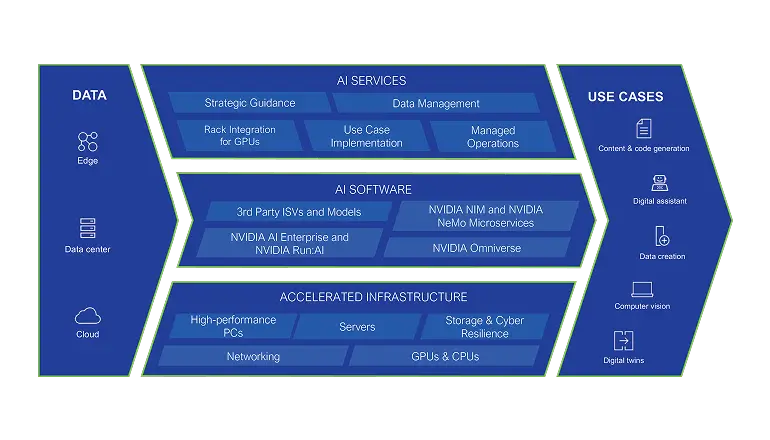
By using the Dell AI Factory with NVIDIA, organizations benefit from:
- Faster time to value through validated architectures and turnkey solutions
- Reduced infrastructure complexity and operational risk
- Ability to scale AI across the enterprise without consistent frameworks
- Lower cost and latency by bringing AI to the data
Why Dell Technologies and NVIDIA?
Dell Technologies and NVIDIA have partnered for more than 25 years to deliver innovative platforms, solutions, and software that help customers drive growth, improve productivity, enhance experiences, and accelerate transformation.
Dell Technologies engineers the machines that power high-performance AI. The Dell Pro Max runs AI tasks with ease and delivers enhanced security and simple manageability. This is a device customers can scale as functional infrastructure to achieve their AI goals.
Dell Pro Max is ideal for:
- Local AI prototyping
- Lowering cloud expenses
- Reducing security concerns
NVIDIA AI Enterprise is a cloud-native software platform that speeds up data science workflows and simplifies AI development. NVIDIA enhances stability, provides support, and applies security patches to the AI Factory, while NVIDIA GPUs boost compute power for enterprise-grade AI.
Together, Dell and NVIDIA provide these technical outcomes:
- Accelerated compute for training, inferencing, and agentic workloads
- Integrated software stack for development
- High-performance storage and networking for AI pipelines
- Secure on-prem, edge, and hybrid deployment options

Insight as your AI Factory guide
As a Solutions Integrator, Insight assists clients with translating, designing, and orchestrating their AI initiatives to speed up adoption while minimizing risk. We are your trusted guide to help navigate the process of running workloads anywhere using the Dell AI Factory with NVIDIA infrastructure, starting with:
- Identifying use cases to inform infrastructure requirements
- Determining the AI model that meets performance goals
- Right-sizing your investment
Insight’s AI experts consult on strategy, architecture, deployment, and operational services to help clients maximize their AI investments and tackle initiatives with greater confidence.
See how other industries are using AI to get ahead.
Success story: See how we built an automation solution for a grain distributor to improve delivery routes (reducing carbon emissions) and prevent food spoilage.
The organizations that win with AI won’t be the first to experiment — they’ll be the first to operationalize. Insight will get you there faster.
1 Dell Technologies. (June 2025). Survey across 2,850 business and IT decision-makers across 40 locations, all segments.
2 Ibid.
 Monthly perspectives from global tech leaders.