Article Enterprise Device Refresh Planning: August Market Update

Key takeaways
- Enterprise device refresh planning is becoming more complex as vendors adjust pricing, promotions, and product portfolios.
- Lenovo customers face a September pricing deadline that may impact purchasing decisions.
- Microsoft Surface pricing changes create both budget pressures and potential savings opportunities.
- Dell portfolio transitions could affect device availability and refresh timelines.
- HP and Microsoft continue expanding AI-focused hardware strategies beyond traditional PCs.
- Organizations should evaluate AI devices within broader workplace, security, and lifecycle planning initiatives.
Commercial PC pricing continues to change, and purchase timing is becoming more important. Refreshes planned for late 2026 or 2027 may cost more or take longer than current budgets assume — making it critical for IT leaders to validate upcoming device demand, current pricing, and availability before budgets and device standards are finalized.
Devices costs are rising. Purchase windows are tightening. And quote validity, configuration costs, and lead times vary across the market.
For IT leaders, the risk is both financial and operational — especially for custom configurations, specialized devices, and large-volume orders.
Why this matters
Component and memory cost pressure continues to affect device pricing, with higher memory and storage configurations potentially more exposed. Current pricing protection also depends on when products physically ship, not simply when an order is placed.
Recommended action
Review Lenovo demand tied to upcoming refreshes, Windows 11 migrations, and budget cycles now. CTO Special Bid orders must ship by Dec. 31, 2026, and Top Seller orders must ship by Sept. 30, 2026, to hold current rates.
Select Surface pricing changed Aug. 1.
Microsoft adjusted MSRP across select Surface for Business devices on Aug. 1. Some configurations increased in price, while several Qualcomm-based Surface devices decreased.
Why this matters
Surface pricing is not moving in one direction across the portfolio. Depending on the configuration, clients may have an opportunity to improve price, performance, or AI capabilities by reconsidering their current standard.
Recommended action
Reprice your current Surface standard and compare approved configurations before your next purchase. Alternative configurations may provide better value while still meeting user requirements.
Why this matters
Clients already evaluating AI PC refresh opportunities may be able to reduce near-term acquisition costs by purchasing within the promotional window.
Recommended action
Confirm eligibility, approved configurations, and purchase timing before Sept. 30.
Availability has stabilized, but configuration still matters.
Commercial PC availability has largely stabilized, but lead times still vary by OEM, configuration, and component selection. Channel inventory may ship quickly, while configure-to-order and build-to-order devices require more time.
Why this matters
Waiting until final budget approval to begin sourcing can put deployment timelines at risk, particularly for custom configurations, specialized devices, and large-volume orders.
Recommended action
Validate availability and lead times while budgets and device standards are still being finalized.
| OEM | Typical CTO/BTO lead time | What to watch |
|---|---|---|
| Dell | ~1-2 weeks typical | Select builds can reach ~13 weeks; high-end DDR5 configurations may take longer. |
| Lenovo | ~2-3 weeks typical | Most notebooks and workstations have normalized, but select configurations remain constrained. |
| HP | ~4-6 weeks | Timing is configuration-dependent, and some builds may take longer. |
| Microsoft Surface | ~6 weeks | Select builds may require 8-9+ weeks; 32GB Intel configurations are particularly constrained. |
| Apple | ~6-12+ weeks for Mac | Timing varies by product and build type; higher-capacity and cellular iPad configurations may take longer. |
Point-in-time estimates. Channel inventory and CTO/BTO lead times are subject to change. Availability varies by model, configuration, location, and quantity.
Three actions IT leaders should take now
1. Review device refresh plans for the next 12–18 months and identify where pricing changes, availability, or deployment timing could affect planned purchases.
2. Revalidate pricing assumptions, quote-expiration dates, channel inventory, and CTO/BTO lead times for preferred configurations before budgets and timelines are finalized.
3. Evaluate alternative OEMs, processors, or configurations where appropriate, and align purchasing decisions with deployment capacity and business timelines. Engage Insight before major refresh decisions are finalized to understand available options.
The takeaway
Device strategy in 2026 requires managing both pricing risk and availability risk. Organizations that plan earlier may be better positioned to control costs, maintain deployment timelines, and secure preferred configurations. Before your next refresh, validate whether your current device standards still make sense based on today's pricing, availability, and alternative options.
How Insight can help
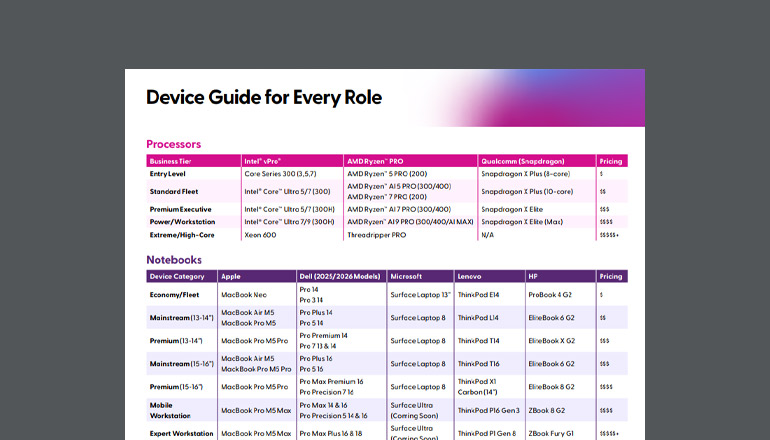
Through Dare to Compare, Insight can help your team compare Apple, Dell, HP, Lenovo, and Microsoft Surface across pricing and available configurations, channel inventory, and lead times, alternative processor and platform options, Windows 11 and AI PC readiness, and lifecycle requirements.
Ready to Dare to Compare? Contact your Insight account team to schedule a Device Strategy Review.
About the author:

Mark Berlin
VP, Partner Management & Alliances, Insight
Mark brings over 20 years of IT experience. His focus is on integrating best-in-class solutions to improve clients' business operations. He is a dynamic sales and marketing leader who excels in competitive environments with ambitious goals. Mark is known for his ability to lead teams, form partnerships, and deliver measurable results through strategic execution.
By Mark Berlin / 22 Aug 2026 / Topics: Devices , Device lifecycle , Windows 11