Infographic text included for screen readers:
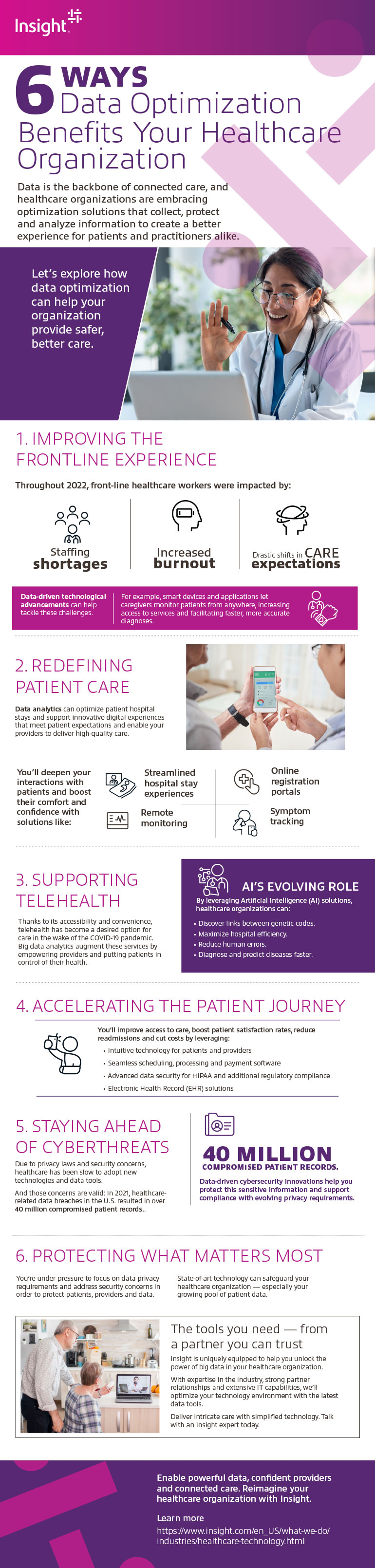
6 Ways Data Optimization Benefits Your Healthcare Organization
Data is the backbone of connected care, and healthcare organizations are embracing optimization solutions that collect, protect and analyze information to create a better experience for patients and practitioners alike.
Let’s explore how data optimization can help your organization provide safer, better care.
1. Improving the front-line experience
Throughout 2022, front-line healthcare workers were impacted by:
- Staffing shortages
- Increased burnout
- Drastic shifts in care expectations
Data-driven technological advancements can help tackle these challenges.
For example, smart devices and applications let caregivers monitor patients from anywhere, increasing access to services and facilitating faster, more accurate diagnoses.
2. Redefining patient care
Data analytics can optimize patient hospital stays and support innovative digital experiences that meet patient expectations and enable your providers to deliver high-quality care.
You'll deepen your interactions with patients and boost their comfort and confidence with solutions like:
- Streamlined hospital stay experiences
- Remote monitoring
- Online registration portals
- Symptom tracking
3. Supporting telehealth
Thanks to its accessibility and convenience, telehealth has become a desired option for care in the wake of the COVID-19 pandemic. Big data analytics augment these services by empowering providers and putting patients in control of their health.
AI’s evolving role
By leveraging Artificial Intelligence (AI) solutions, healthcare organizations can:
- Discover links between genetic codes.
- Maximize hospital efficiency.
- Reduce human errors.
- Diagnose and predict diseases faster.
4. Accelerating the patient journey
You’ll improve access to care, boost patient satisfaction rates, reduce readmissions and cut costs by leveraging:
- Intuitive technology for patients and providers
- Seamless scheduling, processing and payment software
- Advanced data security for HIPAA and additional regulatory compliance
- Electronic Health Record (EHR) solutions
5. Staying ahead of cyberthreats
Due to privacy laws and security concerns, healthcare has been slow to adopt new technologies and data tools.
And those concerns are valid: In 2021, healthcare-related data breaches in the U.S. resulted in over 40 million compromised patient records.
Data-driven cybersecurity innovations help you protect this sensitive information and support compliance with evolving privacy requirements.
6. Protecting what matters most
You’re under pressure to focus on data privacy requirements and address security concerns in order to protect patients, providers and data.
State-of-art technology can safeguard your healthcare organization — especially your growing pool of patient data.
The tools you need — from a partner you can trust
Insight is uniquely equipped to help you unlock the power of big data in your healthcare organization.
With expertise in the industry, strong partner relationships and extensive IT capabilities, we'll optimize your technology environment with the latest data tools.
Deliver intricate care with simplified technology. Talk with an Insight expert today.
Source: Witts, J. (2022, April 1). Healthcare Cyber Attack Statistics 2022: 25 Alarming Data Breaches You Should Know.