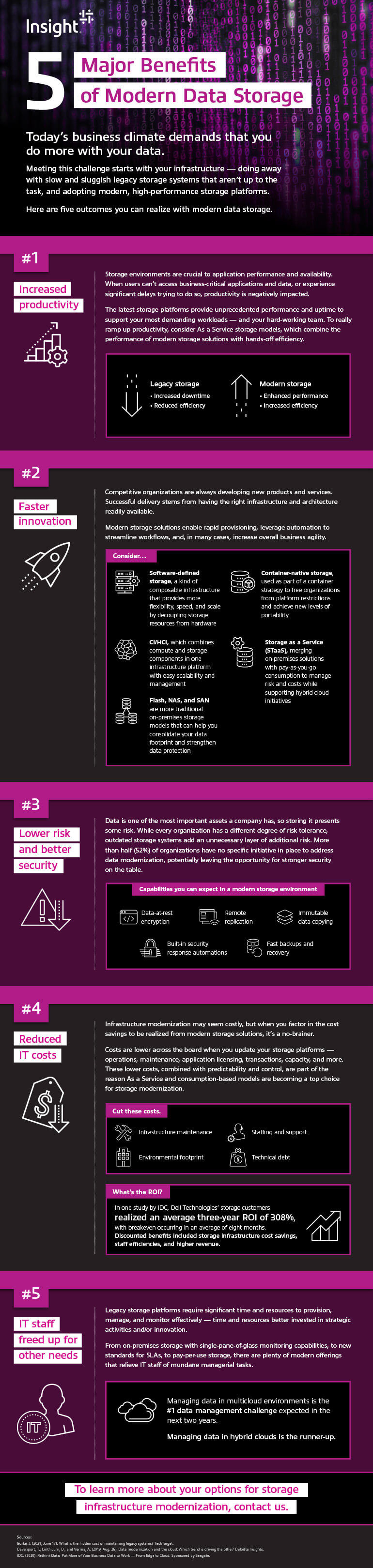
Infographic text included for screen readers:
Today’s business climate demands that you do more with your data.
Meeting this challenge starts with your infrastructure — doing away with slow and sluggish legacy storage systems that aren’t up to the task, and adopting modern, high-performance storage platforms.
Here are five outcomes you can realize with modern data storage. Storage
#1 Increased productivity
Storage environments are crucial to application performance and availability. When users can’t access business-critical applications and data, or experience significant delays trying to do so, productivity is negatively impacted.
The latest storage platforms provide unprecedented performance and uptime to support your most demanding workloads — and your hard-working team. To really ramp up productivity, consider As a Service storage models, which combine the performance of modern storage solutions with hands-off efficiency.
Legacy storage
- Increased downtime
- Reduced efficiency
Modern storage
- Enhanced performance
- Increased efficiency
#2 Faster innovation
Competitive organizations are always developing new products and services. Successful delivery stems from having the right infrastructure and architecture readily available.
Modern storage solutions enable rapid provisioning, leverage automation to streamline workflows, and, in many cases, increase overall business agility. Consider...
Software-defined storage, a kind of composable infrastructure that provides more flexibility, speed, and scale by decoupling storage resources from hardware
Container-native storage, used as part of a container strategy to free organizations from platform restrictions and achieve new levels of portability
CI/HCI, which combines compute and storage components in one infrastructure platform with easy scalability and management
Storage as a Service (STaaS), merging on-premises solutions with pay-as-you-go consumption to manage risk and costs while supporting hybrid cloud initiatives
Flash, NAS, and SAN are more traditional on-premises storage models that can help you consolidate your data footprint and strengthen data protection
#3 Lower risk and better security
Data is one of the most important assets a company has, so storing it presents some risk. While every organization has a different degree of risk tolerance, outdated storage systems add an unnecessary layer of additional risk. More than half (52%) of organizations have no specific initiative in place to address data modernization, potentially leaving the opportunity for stronger security on the table.
Capabilities you can expect in a modern storage environment
Data-at-rest encryption
Remote replication
Immutable data copying
Built-in security response automations
Fast backups and recovery
#4 Reduced IT costs
Infrastructure modernization may seem costly, but when you factor in the cost savings to be realized from modern storage solutions, it’s a no-brainer.
Costs are lower across the board when you update your storage platforms — operations, maintenance, application licensing, transactions, capacity, and more. These lower costs, combined with predictability and control, are part of the reason As a Service and consumption-based models are becoming a top choice for storage modernization.
Cut tese costs
- Infrastructure maintenance
- Staffing and support
- Environmental footprint
- Technical debt
What’s the ROI?
In one study by IDC, Dell Technologies’ storage customers realized an average three-year ROI of 308%, with breakeven occurring in an average of eight months. Discounted benefits included storage infrastructure cost savings, staff efficiencies, and higher revenue.
#5 IT staff freed up for other needs
Legacy storage platforms require significant time and resources to provision, manage, and monitor effectively — time and resources better invested in strategic activities and/or innovation.
From on-premises storage with single-pane-of-glass monitoring capabilities, to new standards for SLAs, to pay-per-use storage, there are plenty of modern offerings that relieve IT staff of mundane managerial tasks.
Managing data in multicloud environments is the #1 data management challenge expected in the next two years. Managing data in hybrid clouds is the runner-up.
To learn more about your options for storage infrastructure modernization, contact us.
Sources:
Burke, J. (2021, June 17). What is the hidden cost of maintaining legacy systems? TechTarget.
Davenport, T., Linthicum, D., and Verma, A. (2019, Aug. 26). Data modernization and the cloud: Which trend is driving the other? Deloitte Insights.
IDC. (2020). Rethink Data: Put More of Your Business Data to Work — From Edge to Cloud. Sponsored by Seagate.